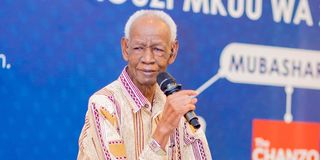
Dar es Salaam. Tanzania’s current political and social challenges cannot be fully understood without examining the erosion of the values that shaped the country at independence, former Prime Minister and First Vice President Joseph Sinde Warioba has said.
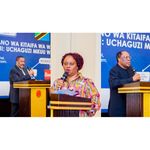
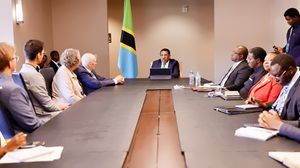
His remarks came as the TCD brought together political leaders, diplomats, civil society representatives and other stakeholders to discuss the country’s democratic future.
Speaking at the Tanzania Centre for Democracy (TCD) National Conference in Dar es Salaam today, Mr Warioba said Tanzania’s founders deliberately built the country around national unity, equality, patriotism, honesty and self-reliance, principles he said had helped the country avoid divisions based on tribe and religion.
He said the weakening of those values had contributed to the emergence of political, religious, tribal and regional divisions that now threaten the country’s social cohesion.
“We need to return to the Tanzania we knew — a Tanzania of peace, equality, patriotism, honesty and self-reliance,” he said.
Mr Warioba said Tanzania’s experience immediately before and after independence offered important lessons for addressing the problems facing the country today.
He recalled that the objectives of the Tanganyika African National Union (TANU), formed in 1954, included preparing Tanzanians for self-government and independence while removing tribal discrimination and other practices that could prevent Africans from being united.
“The first objective was to prepare our people for self-government and independence, and to remove tribal discrimination and anything else that prevented Africans from being united,” he said.
According to Mr Warioba, the principles were not merely political slogans but formed the basis upon which national unity was deliberately constructed.
He said the country’s founding leadership also established ethical standards for public leaders, including the principle that public office was a trust and that leaders were expected to reject corruption and speak the truth.
“Leadership was regarded as a trust. Public office was not meant to be a personal possession,” he said.
He said those principles helped Tanzania develop a strong sense of national identity despite its ethnic and religious diversity.
“We succeeded in building national unity, but today we are seeing tribal groupings, religious divisions and regionalism returning,” he said.
Mr Warioba said the re-emergence of such divisions should be treated seriously because they undermine the foundation upon which peace and stability were built.
He particularly warned against the transformation of political parties into vehicles for narrow group interests.
“The coming of multiparty politics turned the country into new type of discrimination, political parties became new tribes,” he said.
He said Tanzania should preserve multiparty democracy but ensure that competition between political parties did not turn citizens against one another.
“We must preserve multiparty democracy while making sure that it does not divide Tanzanians which is one of the prime challenge we have in our country in the past ten years,” he said.
For Mr Warioba, the solution lies not in abandoning political competition but in strengthening the rules, institutions and values that govern it.
He said Tanzania needed to revisit its constitutional and political history to understand why certain institutions were created and how they were intended to protect national interests.
“We must look at our history because it is in that history that we can find the foundation of our unity,” he said.
He also linked the country’s political challenges to weaknesses in the process through which leaders are selected and elected.
Mr Warioba said citizens must have a genuine opportunity to choose their leaders, warning that political systems could lose public legitimacy when the selection of candidates and leaders was driven by money or narrow party interests.
“If we want to restore the principle that power belongs to the people, then the procedures for choosing leaders must allow citizens to genuinely choose,” he said.
He called for improvements in the electoral system, saying voter registration, voting, counting, verification and announcement of results must be administered impartially.
He said electoral institutions should be sufficiently independent to command public confidence and ensure that elections are viewed as a genuine expression of citizens’ choices.
The former Prime Minister also called for stronger checks and balances between State institutions, particularly Parliament and the Executive.
“The Parliament must be able to perform its functions independently; it cannot be effective if it is subordinate to the Executive,” he said.
He said the Constitution should provide stronger safeguards for ethics, leadership standards and accountability, arguing that institutions were essential to preventing the abuse of power.
“The Constitution must provide for ethics, leadership standards and accountability,” he said.
Mr Warioba also addressed the Union between Tanganyika and Zanzibar, warning that unresolved grievances and growing differences between the two sides could weaken the Union if they were not addressed.
“We have to sit down and discuss the grievances between the Mainland and Zanzibar because the Union cannot be taken for granted,” he said.
He said dialogue should therefore be regarded as a permanent mechanism for resolving political differences rather than something used only when the country faces a crisis.
His call for dialogue was also linked to the broader question of peace.
“Peace is not made with guns, and you cannot protect peace with guns,” he said.
Mr Warioba argued that lasting peace depended on justice, equality, national unity and institutions capable of resolving disputes peacefully.
“Our problems cannot be solved by force; they must be solved through dialogue, justice, equality and institutions,” he said.
He urged Tanzanians to draw lessons from the country’s history rather than allowing current political disagreements to erase the achievements of the past.
For him, returning to the founding principles does not mean returning to the past politically, but restoring the values that enabled Tanzanians from different backgrounds to regard themselves as one people.
He said the task ahead was therefore to rebuild trust in political institutions, strengthen constitutional safeguards, improve electoral processes and revive the ethical standards that once guided public leadership.
He said the conference should provide an opportunity for Tanzanians to reflect honestly on the country’s history, recognise the problems that have emerged and agree on practical ways of rebuilding national cohesion.
“We have to look at where we came from, understand where we are today and decide what kind of Tanzania we want to build,” he said.