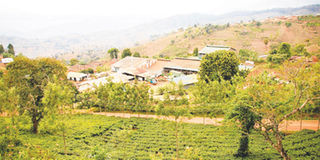
A section of Mponde tea estate in Lushoto District, Tanga region. PHOTO|FILE
What you need to know:
There was hope, at first – for a bright future for the newly-privatised firms. But no sooner had they started fully operating than trouble checked in. In some cases, the process was mired by accusations and counter-accusations flying between investors, members of the community and politicians.
Tanga. When the privatisation agenda was first mooted in the early 1990s, the objective was to bring new capital, technology and management techniques into the then public companies. This came as proponents of nationalisation woke up to the sad reality that at best, state-run companies had become parasites, endlessly sucking the Treasury in subsidies and bailouts.
There was hope, at first – for a bright future for the newly-privatised firms. But no sooner had they started fully operating than trouble checked in. In some cases, the process was mired by accusations and counter-accusations flying between investors, members of the community and politicians.
In Tanga Region, once the country’s economic hub, residents say politics has always reared its ugly head in every privatisation project. One of the most controversial projects is the Mponde Tea Factory.
Some tea growers in the region blame politicians for the collapse of the once-vibrant factory, whose re-possession Treasury registrar Lawrence Mafuru officially announced on January 29, this year.
The government said it was retaking the Lushoto-based factory from the investor, who was accused of breaching terms of the contract. Specifically, the investor was said to have “decided” to pay only half of the sale price of Sh750 million by the set deadline of 2008.
The decision to repossess the factory has left farmers divided with some believing the move is for the better while others are of the view that the investor should have been left to manage the factory, but with some form of support from the government.
A tea grower based in Lushoto District, 76-year-old Silasi Sechambo has no kind words for local politicians. Like a good number of his colleagues, he accuses them of meddling in the affairs of the factory for selfish gain.
“This typically explains how politicians are killing our industries in their pursuit to manage both politics and the economy,” Sechambo, a retired police officer, told The Citizen in a recent interview.
The politicians who has been roped in this saga in Bumbuli Member of Parliament and Minister of State in the Vice President’s Office for Union Affairs and Environment, Mr January Makamba.
He has since sought to clear his name, reiterating that everything that was done was in the best interest of the people of Lushoto.
But what exactly happened?
The government ran the factory until 2007, when the then Presidential Parastatal Sector Reform Commission (PPSRC) sold it to the Usambara Tea Growers Association (Utega).
The association then struck a deal with Lushoto Tea Factory in the management of Mponde and, according to Mr Sechambo, things went quite well for a long time “until politics found its way into the factory”.
Tea growers who are against the government takeover are pushing forward the theory that the other key man at the centre of “this fight”, former Bumbuli MP William Shelukindo, who is also the chairman of all tea schemes in Bumbuli, still retains reasonable influence among the majority of residents in the constituency despite losing the parliamentary seat to Mr Makamba in 2010.
So, there is a general feeling that politicians in the area fear his influence could grow if he’s allowed loose, to manage the strategic factory, according to the chairman of a group of companies that operate the Lushoto Tea Factory, Mr Nawab Mullah.
His sentiments are echoed by the former MP, who believes he is the target of everything that happens at Mponde Tea Factory.
“I am the target of all this,” he told The Citizen by phone.
But Mr Makamba has a different version.
He told The Citizen in an interview: “These allegations are not new. They have existed for a long time now, but the truth is that the factory belongs to wananchi and they (wananchi) were the ones who started complaining about the state of their factory, forcing the government to intervene.”
The writing was on the wall for Lushoto Tea Factory that managing Mponde Tea wouldn’t be an easy task.
Tea growers in Korogwe District had ceased to be members of Utega in 2006. Coincidentally, a tree plantation – the Sakare Tea Plantation – which used to feed the tea processing factory with its much-needed energy is in Korogwe and farmers there decided to take the plantation as their share of Utega assets.
Regrettably, when Lushoto Tea Factory and Utega inked a management deal for the Mponde Factory, the Sakare Tea Plantation was included as one of the assets that would be sold.
Utega, with the help of the investor, paid Sh375 million, which was half of the amount that they were required to pay for the proceeds.
The firm and its partner were thus given the title deed for the factory only to find out that residents around Sakare were still disgruntled by the way the Wood Plantation at their disposal became a property of Utega and partner.
The residents then invaded the Wood Plantation and destroyed planted trees, meaning that Mponde Tea Factory had to depend on alternative sources of firewood power its processing activities.
According to Mr Mullah, that was why the company failed to pay the remaining Sh375 million as required by the sale agreement, signed between Utega and the PPSRC.
“We thought since part of the asset that we had bought had been taken away, there was no reason for us to pay the entire amount,” he said, noting, however, that by the time the Sakare Wood Plantation was taken away from them, they had already invested a reasonable amount in the tea processing factory and in the Wood Plantation.
With the investment, he said, processing capacity increased from 20 metric tonnes of tea leaves per day to 120 metric tonnes per day. “We had also planted eucalyptus trees on the 250 hectares of land at the Sakare Wood Plantation….the factory were doing well and we used to pay farmers after every 15 days,” he told The Citizen.
Rounds of discussions
The encroachment on the Wood Plantation saw policymakers and senior public servants engaging in several rounds of discussions and investigations, the notable ones being the one undertaken by a Parliamentary Parastatal Organisations’ Accounts Committee (Poac) in 2010. Former Prime Minister Mizengo Pinda also threw his weight into the discussions in 2014.
In his remarks, submitted to parliament, former Poac chairman Zitto Kabwe noted that the issue surrounding Sakare Wood Plantation had always been a controversial one and proposed therefore that the 1000-hectare area be divided into two equal halves to accommodate the two parties – Utega/Mponde on one side and Korogwe tea growers on the other.
The committee also proposed that there be mutual understanding and trust between Lushoto Tea Factory and Tanga regional authorities. Utega was also asked to make sure that its operations are open and transparent to its members.
However, the peace didn’t last long. In May, 2013, a group of residents in the area thronged Mponde Factory and ordered the immediate closure of the factory, citing harassment by the investor. Again, Mr Pinda had to intervene.
During his meeting with regional authorities shortly before holding discussions with tea farmers on September 13, 2014, Mr Pinda directed the Tea Board to form a team of experts to work with the Lushoto Tea Factory in the management of the company when it restarts production.
“The investor must also accept to work with a team of government experts so we can know the current status of the factory. Doing so will make it easy for us to know what we must do to reopen it,” he said in Tanga during the September 2014 meeting with regional authorities and tea farmers.
He said once formed, the team and the investor must work together to prepare a work plan for a period of up to three years.
Makamba’s story
Contrary to allegations that he was behind the people who thronged the factory and order its immediate closure in May 2013, the Bumbuli MP said he was not the one who initiated the public rally.
“In fact, I was invited to the rally….wananchi said I must attend the rally so I can listen to what they will have to say….I requested wananchi to stop closing the factory so we could give negotiations a chance. But they insisted and did what was right for them,” said Mr Makamba.
When it happened for the first time during his tenure as MP in 2013, some said it would hurt the ruling party’s prominence in the 2015 general elections.
On the contrary, said Mr Makamba, he won the parliamentary seat convincingly.
He said all procedures were followed before the factory was retaken by the government. “Of course, it has helped me politically since I have been doing what wananchi want….they (Utega/Lushoto Tea Factory) made a mistake of believing that the government would always be slow in making decision,” he said.