Boston Marathon, humility and the Abbott Majors Six Star Medal
By Godfrey Mramba
The Boston Marathon, often referred to as the Mecca of all races, is the world’s oldest annual marathon, according to the Boston Athletic Association (BAA). Organised by the BAA, it began in 1897 and was inspired by the 1896 Summer Olympics in Greece. It started as a 24.5-mile (39.4 km) race with just 15 runners. In 1924, the BAA extended the course to the official marathon distance of 26.2 miles (42.2 km).
Boston is elite for many reasons: the calibre of its runners, the strength of its field, and the difficulty of its course. But what truly defines it is something less visible, a spirit that cannot be measured. As often reflected in The Boston Globe, Boston demands more than speed; it demands respect for the course, appreciation of its history, and the humility to recognise that standing on the start line is an achievement.
Boston 2026 was my final race: The race took place on April 20, and although my time of 3:46 was not my fastest, it was the most enjoyable. For once, I was not chasing a clock. I was chasing completion. I was intentional and grateful.
I did not get there alone: The marathon is not run on race day. It is run in the months before, when there are no cheering fans or medals, only discipline.
A special mention goes to my training partner, Abdulrahman Khamis “Dulla,” who trained with me during the holy month of Ramadan, while fasting and not running the marathon himself. That kind of quiet commitment humbles you.
It is a reminder of what Pope Francis and Sheikh Ahmed el-Tayeb affirmed in 2019 in Abu Dhabi, in the Document on Human Fraternity, that our shared humanity is expressed through acts of selflessness, solidarity, and humility.
The Abbott World Marathon Majors: That truth became real to me as I prepared for my sixth and final race in the Abbott World Marathon Majors—Boston, New York, London, Berlin, Chicago, and Tokyo. Together, these races represent the pinnacle of marathon running. Completing all six earns the Six Star Medal, a symbol not of speed, but of consistency, discipline, and endurance.
My journey to the six majors was not intentional at the start. In 2016, I ran the London Marathon and continued running locally and internationally.
It was only in 2022, after a conversation with Herman Kasekende himself, a Six-Star finisher and one of only eight Ugandans to have achieved that distinction, that the idea of completing all six majors began to take shape. His encouragement was simple: finish what you have started.
Even then, the journey took on deeper meaning in October 2025. One evening over dinner, my elder daughter shared that no Tanzanian had completed all six Abbott World Marathon Majors. That fact surprised me, given our history of runners such as Juma Ikangaa and Filbert Bayi. I was inspired.
It is one thing to run for yourself. It is another to run with purpose: Being the first Tanzanian to complete the six Abbott World Marathon Majors is an honour. This isn’t just a personal milestone; it is something I am proud to carry on behalf of Tanzania.
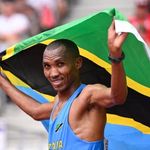
That moment stayed with me all the way to Boston: At the front of the race, Alphonce Simbu delivered an extraordinary performance, finishing second in 2:02:47, a national record and one of the fastest times recorded in Boston. His improvement from the previous year reflects discipline and intent. He has made Tanzania proud.
But Boston has a way of reminding every runner that comparison is not the point: As Michael Connelly writes in 26 Miles to Boston: “People don’t come to Boston to run its race. They come to Boston to justify their existence.”
It sounds dramatic, but somewhere along the course, it begins to feel true.
And then, step by step, you understand another of his observations:
“Each new step presented an obstacle as it arrived and became an accomplishment as it passed.”
That is the marathon: If there is one lesson I take from completing the six majors, it is this: be intentional but remain humble. Because in the end, while the medal may hang around your neck, the journey belongs to many.
As I reflect on that final stretch in Boston, I am reminded that this achievement did not start with me. It was shaped by those who encouraged me, challenged me, and believed it was possible, from a conversation with Herman to a simple but powerful inspiration from my daughter.
It is, for me, a real honor not just to complete the six majors but to carry that achievement, in a small way, on behalf of Tanzania.
More importantly, I hope it serves as a reminder that more Tanzanians can do the same and more. Not just in marathon running, but in whatever goals they set for themselves. Talent alone is not enough. What makes the difference is discipline, the willingness to show up consistently, and the ability to learn and keep going when the path is difficult.
With discipline and humility, there is no reason why many more Tanzanians cannot stand on the global stage and quietly achieve extraordinary things.
Godfrey Mramba is Managing Partner at Basil & Alred. The views expressed do not necessarily represent those of Basil & Alred.