Tanzania’s role in Africa’s liberation as the world remembers Mandela’s freedom

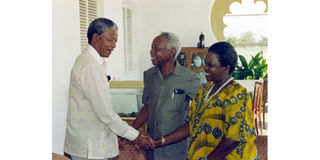
Nelson Mandela with Mwalimu Nyerere and Maria Nyerere during his visit to Tanzania after his release in 1990

What you need to know:

  • Among the African nations most closely linked to Mandela’s fight for justice was Tanzania, whose government, under President Julius Nyerere, played a pivotal role in supporting the African National Congress (ANC) and other liberation movements across southern Africa.

On February 11, 1990, the world watched as South Africa’s foremost anti-apartheid leader, Nelson Mandela, emerged from Victor Verster Prison after 27 years behind bars.

His release marked a historic moment, not only for South Africa but for the African continent and the global struggle against racial injustice.

Mandela’s walk to freedom symbolised hope, resilience, and the unwavering pursuit of democracy, ushering in a new chapter for a nation long divided by apartheid.

His release was the culmination of decades of struggle, both within South Africa and across the continent.

During his imprisonment, Mandela became the embodiment of resistance against systemic oppression, a figure whose moral authority transcended borders.

Among the African nations most closely linked to Mandela’s fight for justice was Tanzania, whose government, under President Julius Nyerere, played a pivotal role in supporting the African National Congress (ANC) and other liberation movements across southern Africa.
Tanzania’s backing of Mandela and the ANC was not merely rhetorical. From Tanganyika’s independence in 1961, the country provided sanctuary, training, and logistical support to exiled South African activists.

Mandela himself made a secret visit to Tanganyika in the early 1960s, establishing direct contacts with Tanzanian leaders who became steadfast allies of the anti-apartheid struggle.

These efforts were part of Tanzania’s broader commitment to Pan-African solidarity, rooted in Nyerere’s belief that the freedom of one African nation was inseparable from the freedom of all.

In March 1990, a month after his release, Mandela visited Dar es Salaam, where he was welcomed by thousands of citizens and political leaders.

The visit affirmed the enduring bond between South Africa’s liberation movement and Tanzania’s decades-long support.

Mandela met extensively with Nyerere, whose leadership had championed southern African liberation on the international stage.

Their discussions reflected a shared vision for a continent free of oppression, where democracy, equality, and human dignity would prevail.

During his visit, Mandela publicly acknowledged Tanzania’s critical role in sustaining the anti-apartheid struggle.

He highlighted the country’s provision of safe havens for exiled activists and bases for political and military training.

Tanzania had hosted ANC operatives at a time when apartheid South Africa sought to isolate them from the international community.

Mandela described this support as more than strategic assistance; it was a profound demonstration of African solidarity and moral courage.

The relationship between Mandela and Tanzania extended beyond politics to personal admiration and mutual respect.

Mandela often cited Nyerere as an inspiration, recognising his unwavering commitment to equality and human rights.

Nyerere’s vision of a free and united Africa deeply influenced Mandela’s philosophy, shaping the policies he later pursued as South Africa’s first democratically elected president in 1994.

Mandela’s freedom and subsequent travels across Africa underscored a simple truth: apartheid was not only a South African issue but a continental concern.

The liberation of South Africa was intrinsically linked to the struggles of neighbouring nations and the broader fight against colonialism and oppression.

Tanzania exemplified the power of regional cooperation and moral leadership in times of crisis.

The significance of Mandela’s release also lay in its symbolic power. Emerging from prison, he carried not a message of revenge but one of reconciliation.

His ability to forgive oppressors while honouring the sacrifices of his comrades became a model for transformative leadership, influencing peace processes across Africa and the world.

For Tanzanians, this approach resonated deeply, reflecting values that had guided Nyerere’s policies of unity, peace, and social justice.

Mandela’s example offered a vision of leadership where moral authority outweighed political power, a lesson that continues to inspire generations in South Africa and Tanzania.

Today, decades after Mandela’s release and his passing in 2013, Tanzania continues to celebrate his legacy.

Commemorative events, educational initiatives, and public discussions honour the historic partnership between Mandela and Tanzania.

Schools and universities incorporate lessons from his life into their curricula, highlighting how international solidarity and cross-border collaboration were essential in achieving freedom.

Mandela’s philosophy of reconciliation and justice remains a guiding principle, particularly in Tanzania, where the values of human dignity, equality, and Pan-African unity are deeply embedded.

The enduring bond between Mandela and Tanzania is more than historical; it is emblematic of Africa’s broader story of liberation.

Mandela’s journey from prison to presidency illustrates the power of resilience, moral courage, and international solidarity.

Tanzania’s support for Mandela and the ANC serves as a reminder that the fight for freedom often requires collective action, mutual support, and unwavering commitment to principles larger than oneself.

As the world remembers Mandela’s historic walk to freedom, it is also a moment to reflect on the countries and leaders whose support made that journey possible.

Tanzania, with its steadfast dedication to justice, remains central to this narrative, a partner in Africa’s liberation and a witness to the triumph of hope over oppression.

Mandela’s freedom and the enduring friendship between South Africa and Tanzania continue to inspire a continent and the world.