Sh405 billion allocated for six health sector priorities in Zanzibar

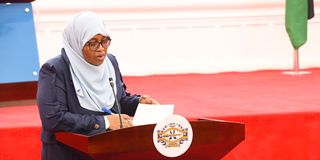
Deputy Minister for Health, Dr Saada Mkuya, presents the Ministry’s budget estimates for the 2026/27 financial year during the Budget Council meeting held at Chukwani, Unguja, Zanzibar. PHOTO | COURTESY
Unguja. The Ministry of Health in Zanzibar has requested parliamentary approval of Sh405.89 billion to implement six priority areas aimed at improving healthcare delivery, infrastructure development, medical equipment, digital systems and workforce capacity.

Presenting the ministry’s budget speech on Tuesday, May 19, 2026, Acting Minister for Health, Dr Saada Mkuya, said the proposed budget for the 2026/27 financial year represents a 10.23 percent increase from Sh368.15 billion allocated in the previous financial year.

She said the increase is intended to strengthen key areas of the health sector.

Among the priority projects are the construction of the specialised cancer treatment hospital at Binguni, continuation of the North Unguja Regional Hospital project at Mahonda, expansion of Mnazi Mmoja Hospital and strengthening specialised cardiac treatment services at Lumumba Hospital.

Other planned projects include construction of regional hospitals in South Makunduchi, North Wete and South Chake Chake in Pemba, as well as a specialised eye treatment hospital at Mazizini, Unguja.

Dr Mkuya also said the ministry plans to construct offices for the food, medicines and cosmetics laboratory at Chamanagwe in Pemba, expand primary healthcare centres and strengthen the health workforce through recruitment.

“In addition, we expect to train specialist and super-specialist healthcare professionals, strengthen digital health services, purchase modern laboratory equipment and improve the availability of medicines and medical supplies,” she said.

She added that the government also plans to establish and operationalise the Health Sector Development Fund to support training, procurement of medical equipment and improvement of health infrastructure.

"The ministry also intends to establish professional regulatory institutions, including the Medical Council, Nurses and Midwives Council, Community and Environmental Health Officers Council, Laboratory Professionals Council, Traditional and Alternative Medicine Council and the Private Hospitals Advisory Board," she said.

According to Dr Mkuya, Sh141.11 billion, equivalent to 34.8 percent of the proposed budget, has been allocated to preventive healthcare services and health education targeting communicable and non-communicable diseases.

Meanwhile, treatment services have been allocated Sh184.89 billion, equivalent to 45.6 percent of the total budget.

She further said the Medical Stores Agency procured medicines, laboratory reagents and medical equipment worth Sh9.07 billion and distributed them to health facilities in Unguja and Pemba.

Challenges remain

Despite progress recorded in the 2024/25 financial year, Dr Mkuya said the ministry continues to face several challenges, including congestion in health facilities caused by staff shortages and patients bypassing the referral system.

She also cited the growing burden of non-communicable diseases (NCDs), increasing road accidents and shortages of specialist and super-specialist doctors, nurses and other professionals.

Another challenge, she said, is inadequate funding for recurrent expenditure and development projects.

She noted that by March 2026, the ministry had received Sh185.42 billion, equivalent to 67 percent of the estimates for the first nine months of the financial year.

Maternal and child health

Dr Mkuya said the government continues investing in maternal and child health services through various interventions that have helped reduce maternal mortality linked to pregnancy from 145 deaths per 100,000 live births in 2023 to 121 deaths in 2025.

She also said deaths among newborns within the first month after birth declined from 13.2 deaths per 1,000 live births in 2023 to 11 deaths per 1,000 live births in 2025.

“In reducing maternal and newborn deaths, the ministry continues implementing the M-Mama referral system for pregnant women and newborn babies,” she said.

Presenting the opinion of the House of Representatives Social Welfare Committee, committee member Shaame Ali Ali said that despite significant investment in hospital construction, service delivery in some facilities remains inadequate.

“The committee advises the government to closely monitor service delivery in hospitals in order to achieve the intended goals,” said Ali.

The committee also urged the government to speed up construction of a warehouse for medicines and medical equipment to help the Medical Stores Agency address storage shortages when receiving large consignments.