Zanzibar forest gets boundary beacons to curb encroachment
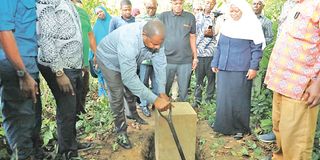
The minister of Agriculture, Suleiman Masoud Makame installs the first boundary beacon to strengthen protection of Ngezi Vumawimbi Forest Reserve through clear demarcation of its borders. PHOTO | COURTESY
Ngezi Vumawimbi Forest Reserve, located in northern Pemba, is among the few remaining coastal forest areas in Africa and is regarded as one of Zanzibar’s most ecologically significant natural assets.
Pemba. A coastal forest in Zanzibar is set to receive enhanced protection following the installation of boundary markers aimed at curbing encroachment and reducing long-standing land-use disputes.
Ngezi Vumawimbi Forest Reserve, located in northern Pemba, is among the few remaining coastal forest areas in Africa and is regarded as one of Zanzibar’s most ecologically significant natural assets.
Covering about 20 square kilometres, it is the largest of three remaining indigenous forest patches on Pemba, alongside Msitu Mkuu and Ras Kiuyu forest reserves. These forests represent the last remnants of ecosystems that once covered much of the island.
Pemba, which spans about 1,000 square kilometres, has a population density of more than 500 people per square kilometre, with many residents dependent on natural resources such as firewood, timber and farmland for their livelihoods.
As a result, forests on the island face sustained and intensifying pressure. Over the past two decades, Pemba has lost an average of 3.4 percent of its forest cover annually, leaving less than 10 percent of its original vegetation intact, according to conservation estimates.
Research conducted in collaboration with Zanzibar’s Department of Forestry has highlighted the ecological value of Ngezi Vumawimbi, documenting dozens of plant species not previously recorded on the island, including several that may be new to science.
One of the key findings comes from botanists from Italy’s University of Pavia, working with conservation organisation Istituto Oikos Zanzibar and its East Africa partners.
The researchers identified a 300-hectare stand of Intsia bijuga forest, a hardwood species known locally as Mbambakofi and internationally as Borneo teak.
The tree, prized for its durable timber, has been heavily logged across Southeast Asia, the Pacific and Madagascar. Although historical records indicate it was collected on Pemba in the early 1900s, it had not been documented on the island for decades.
The survey confirmed that a reproducing population survives in Ngezi Vumawimbi, believed to be the only known population of the species in Africa, a finding conservationists say significantly elevates the global importance of the reserve.
Environmental experts warn that forest loss on Pemba has reduced soil water retention, increased erosion and heightened drought risk, while also leading to the disappearance of medicinal plants, wildlife habitats and cultural values linked to forest landscapes.
To safeguard the reserve, authorities have installed 100 permanent boundary markers along its official borders to prevent encroachment and reduce disputes between farmers and conservation authorities.
The initiative forms part of the GREEN project—Generating Resilience through Ecological Enhancement in Ngezi Forest—led by Oikos in partnership with Zanzibar’s Department of Forestry and funded by the Critical Ecosystem Partnership Fund.
Boundary lines were verified through consultations with local communities and leaders from neighbouring administrative areas, a process intended to foster local ownership and compliance.
The first marker was installed on December 7, 2025, by Zanzibar’s Minister of Agriculture, Suleiman Masoud Makame, accompanied by Principal Secretary Noah S. Said.
Officials said the markers remain the property of the Ministry of Agriculture, warning that their removal or damage will attract penalties and that all activities within the reserve require prior authorisation.
Officials said the markers remain the property of the Ministry of Agriculture, warning that their removal or damage will attract penalties and that all activities within the reserve require authorisation.