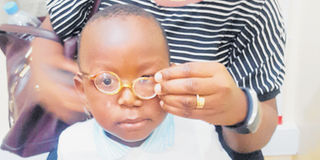
David George with his mother adjusting the spectacles. PHOTO|TASNEEM HASSANALI
What you need to know:
David inclined further forward, bringing his eyes even closer to the piece of paper, focusing in and out as if adjusting his eyes to see what’s drawn or written on the paper.
David George, a three-year-old patient at the CCBRT’s (Comprehensive Community Based Rehabilitation in Tanzania) paediatric clinic, was closely observing a piece of paper, which had written notes on.
David inclined further forward, bringing his eyes even closer to the piece of paper, focusing in and out as if adjusting his eyes to see what’s drawn or written on the paper.
Seated next to David was his mother Rehema Mkumbo who pulled him back and reached out to her purse. “When my son was just a few months old, he got a very high fever, which was uncontrollable,” began Mrs Mkumbo whilst fetching out a round-framed spectacles from her purse.
Trying to adjust the disabled glasses on his son, she explained that the left hand of the spectacles broke as it fell on the ground few weeks back and that she is planning to adjust it soon. “When he was about six months old, I noticed his right eye was not looking at the same direction as his left eye (makengeza), and it is on his eighth month, I brought him here for a check-up,” Mrs Mkumbo explained the cause.
David was the youngest member in the family to have spectacles by the age of 10 months. “The doctors say it is curable, especially because I brought him at a very early stage. David has been told to wear spectacles all the time and come for regular check-ups,” the mother added.
David has been a disciplined patient at the paediatric clinic, regularly being attended by his optometrist Lydia Kiwelu who has been observing David since his first clinic. “David was a victim of convulsion when he was a baby, a medical condition where the body shakes uncontrollably as the muscles in the body relax and contract repeatedly and rapidly. With David’s case, his fever went uncontrollable that affected his vision,” said Ms Kiwelu.
David was diagnosed with a high refractive error and was prescribed spectacles as his first treatment. “We asked David’s mother to bring him at an interval of every six months so that we can examine his progress,” Ms Kiwelu denoted that David’s condition is curable.
The wrong belief that cause late diagnosis
Unlike David’s mother, there are many parents who neglect their child’s eye sight because it is not a life-threatening problem. Overhearing a lurid conversation of a mother talking to the father of her child after a clinical diagnosis, ‘the doctors asked me to make spectacles for our son. What’s the need? We will just feed him carrots and vegetables and he will be okay.’
Fatema Alibhai, an optometrist at CCBRT explained to Your Health that she has to attend to many such parents who seek an alternative to spectacles. “I get quite a number of primary-aged school children who cannot see near objects or distant objects and the fact that it is curable with spectacles doesn’t seem to comply with all the parents,” she said.
She further added, “The parents usually ask common questions, such as, ‘is there any dawa (medication) or a diet’ that can correct their child’s refractive error. A wrong belief of ‘why my child needs a spectacle at a small age’ jeopardizes the quality of life of their child.”
Some of the consequences of delayed diagnosis are low concentration in class, which directly affects the learning process and performance in school and out-of-class behaviour develops because of their teacher’s action on them upon low competency in class, explained Ms Alibhai.
Myopia in school going children
An 11-year-old student of the Temboni Primary School walked in Ms Alibhai’s diagnosis room. As the boy’s father took a back-seat, he explained to Ms Alibhai that lately his son has been complaining about persistent headaches.
Upon being questioned by Ms Alibhai, the standard-five pupil said, “I don’t see clearly on the black-board so I tend to copy notes from my friend. When I strain my eyes in trying to focus what the teacher is writing on the board, I get headaches.”
The boy explained that this is causing him to lag behind in class and his teachers might not like that fact that he has to copy everything from his class-mate. The boy was prescribed spectacles to correct his refractive errors.
According to Mr Bubalan Kothandapani, the head of Optical at CCBRT, myopia cases are most common and affects school-going children who cannot see the blackboard, such as the young student from Temboni Primary School. “Teachers play a very important role in naturally picking up eye problems in a child. These children should be understood and identified by teachers and have their parents informed immediately,” he said.
Mr Kothandapani explains that the refractive error such as the inability to see far objects can either be at birth or can be acquired. At the early stages, such as 0-5 years, it is difficult to identify the problem as children usually play with near objects. It is only when they go to school, they notice ambiguity on what the teacher writes on the board.
“If myopia is left long, uncorrected, then the eye loses its ability of seeing the object completely. So in that case, their visual acuity goes down leading to lazy eye or squinting,” Mr Kothandapani explained.
According to analysis ‘Causes Of Vision Loss Worldwide’ in The Lancet Global Health journal, it was estimated that uncorrected refractive error was the most common cause of distance vision impairment, affecting 108 million persons, and the second most common cause of blindness globally.The economic burden of uncorrected distance refractive error, largely caused by myopia, was estimated to be $202 billion per annum.
Though there are no statistics per se available of how many children are affected by eye errors in Tanzania, Mr Kothandapani believes that 1 in 10 children in Tanzania have at least one kind of refractive error.
20 years back when Mr Kothandapani began the practise of optometry, the awareness was not as widespread as today. “Though the awareness is better now, I still believe that eye, even today, is a neglected part of the body. Especially in low-income families, basic needs are always prioritised ahead of let’s say getting a spectacle made to correct a squint-eye,” Mr Kothandapani speaks today’s reality.
Liaising with challenges aforementioned by Ms Alibhai, Mr Kothandapani added that parents have an incorrect perception that when their child starts wearing spectacles, the eyesight problems will increase.
“Even though we advise and explain the parents that how a refractive error or squint eyes can be corrected by a lens, they think we are misguiding them. The same parents and children, we have observed, come in five or sometimes six times to consult the same problem. They have to understand that any refractive error will not just solve naturally,” he added a persistent challenge.
Don’t get too friendly with the gadgets
Children playing with gadgets such as a phone or a tablet holding it very close to their eyes is definitely harmful, according to Mr Kothandapani. The high intensity light, usually known as the blue light radiation emitted from these gadgets, including the television is not very good for the eyes.
“The blue light might cause retinal problems and damages in the long run. When the intensive playing with gadgets becomes a habit, it causes the eyes to come in, what we call convergence, an ability to accommodate seeing the near objects. If this convergence is too much, it can lead to a cross-eye. This happens very rarely, but there is a risk that it can occur,” Mr Kothandapani explains.
He further cautions the parents that when your child watches television, make sure they maintain a minimum distance, which is usually 10ft.
There are also spectacles designed to cut the blue light but children usually don’t like wearing them hence they are more suitable for adults who spend too much time on laptops, television or phones.