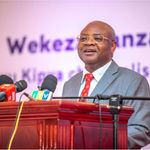
Dar es Salaam. The Minister of State in the President's Office (Planning and Investment), Prof Kitila Mkumbo, has revealed how the private sector influenced the revision of the government's long-term economic projections under Tanzania’s Vision 2050, stressing the role of business and investment in the economic growth. Prof Mkumbo said initial government projections had placed the size of the economy at between $500 billion and $700 billion by 2050, but the private sector argued for a more ambitious growth target.
He said after consultations with the private sector, they resolved to adopt a target of $1 trillion. “The private sector argued that with serious and sustained investment, Tanzania could achieve a $1 trillion economy. After discussions, we agreed to adopt that target,” he said, underscoring the influence of business leaders in shaping the country’s long-term development vision. Prof Mkumbo was speaking at celebrations to mark the 25th anniversary of the CEO Roundtable of Tanzania (CEOrt) at the weekend.
Prof Mkumbo said the government was proud of its close collaboration with the private sector in driving economic and social development in line with Vision 2050, noting that the country’s demographic profile made such partnerships essential.
“We have several projections under Vision 2050, and there is a lot to be done, including heavy investment in human capital, given that about 70 percent of our population is youth. This can only be achieved through strong partnerships between the government and the private sector,” he said. He commended CEOrt for its contribution to Tanzania’s economic transformation over the past 25 years, describing the platform as critical in stimulating growth and sustaining dialogue between policymakers and business leaders.
Reflecting on the period when CEOrt was founded in 2000, Prof Mkumbo said Tanzania was emerging from the Highly Indebted Poor Countries (HIPC) initiative following reforms spearheaded by the late President Benjamin Mkapa and was still internalising the market economy model. “At that time, we were defining the respective roles of the State and the private sector and were only five years into economic liberalisation,” he said. He noted that Tanzania’s GDP growth rate at the time stood at about 4.5 percent, with GDP per capita of roughly $453 and total GDP of $12.37 billion. “If you compare those figures with where we are today, the contrast is striking,” he said.
According to the minister, the economy has grown to about $90 billion over the past two decades, while GDP per capita has increased to around $1,272, driven by business expansion, increased investment, and population growth.
Looking ahead, Prof Mkumbo said achieving a $1 trillion economy by 2050 would depend on deepened collaboration between the government, public institutions, and the private sector. CEOrt chief executive officer, Ms Santina Benson said the organisation had, between 2005 and 2010, strengthened its engagement by investing in leadership and institutional development, leading to initiatives such as the CEO Scholarship Fund, the Enhancing Public Service Leadership (EPSL) programme, and the 3PF Task Force.
She said the initiatives supported public sector reform, including engagement with the Police Force Reform Programme, and promoted ethical leadership and anti-corruption awareness.
CEOrt chairman, Mr David Tarimo, said the organisation was established at a pivotal moment in Tanzania’s economic transformation, when there was a clear need for a trusted platform to connect senior business leaders with government decision-makers.
“One of CEOrt’s earliest milestones was a high-level engagement inaugurated under the leadership of President Benjamin Mkapa, which helped establish the principle that development outcomes are strongest when government and the private sector engage through open, structured, and trust-based dialogue,” he said.
During the celebrations, CEOrt launched a legacy booklet and honoured members and institutions that have contributed to its 25-year journey.
Visionary Leader Awards were presented to the late Ali Mufuruki, Leonard Mususa, and Yogesh Maneck, while Champion Awards went to institutions including Vodacom, Stanbic Bank, and Yas Tanzania.