China's Xi calls for 'equal, multipolar world' as he meets Uruguay leader
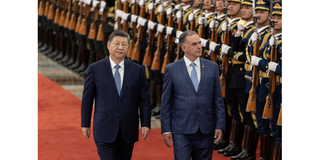
Uruguayan President Yamandu Orsi walks with Chinese President Xi Jinping during a welcome ceremony at the Great Hall of the People in Beijing, China, February 3, 2026.
Beijing. China and Uruguay should work together to advance an "equal and orderly multipolar world", President Xi Jinping told his counterpart Yamandu Orsi on Tuesday, as their nations signed up to cooperate in areas from trade to the environment.
Orsi's visit is the first by a South American leader to the Chinese capital since the United States invaded Venezuela in January and captured then President Nicolas Maduro in a raid.
A media pool report cited Xi as saying China backed Latin American and Caribbean nations in upholding sovereignty, security and development interests, to help defuse a volatile international situation and "escalating unilateral bullying".
China and Uruguay should "work together to advance an equal and orderly multipolar world and an inclusive, universally beneficial economic globalisation," Xi said in his remarks.
The meeting comes in the wake of a flurry of visits to China by Western prime ministers this year, from Britain's Keir Starmer to Canada's Mark Carney and Finland's Petteri Orpo.
Orsi said the strategic partnership of China and Uruguay was going through its "best moment," and called for both nations to "commit to raising it to a new level", the pool report added.
He is leading a delegation of 150, including business leaders, on a visit from Sunday until February 7, which will also swing through the commercial hub of Shanghai.
China and Uruguay signed a declaration to deepen a strategic partnership on Tuesday, as well as 12 documents to cooperate in areas ranging from science and technology to the environment, intellectual property and the meat trade.
Uruguay would like to increase trade in goods, especially through diversification, and invest more strongly in services and investment, the pool report added.
The timing of the visit is symbolically important for China, said Francisco Urdinez, a professor at the Pontifical Catholic University of Chile.
"For Beijing, hosting Orsi ... signals that South American countries remain eager to engage, despite the increasingly polarised geopolitical environment."
Thai military officials said the complex had housed thousands of people, many of them victims of human trafficking,
But Uruguay's engagement with Beijing is likely to be shaped by renewed U.S. attention to Latin America and concerns about China's involvement there, said Margaret Myers, director of the Asia & Latin America Program at the Inter-American Dialogue.
"Following actions in Venezuela, both China and many Latin American nations are weighing the prospects of continued U.S. intervention in the region."
Global south ties
China "is willing to work with Uruguay and other regional countries to deepen and solidify the building of a China-Latin America community with a shared future," Xi said.
It backs Uruguay in taking on the rotating presidency of the Group of 77+, he added, aiming to boost solidarity in the Global South.
"The world today is undergoing profound changes unseen in a century, with a complex and volatile international situation and escalating unilateral bullying," Xi said, adding that China had always attached great importance to ties with Latin America.
China was the top destination for Uruguayan exports in 2025, taking agricultural products from wood pulp to soybeans and beef.
Uruguay, which ran a trade surplus of $187.1 million with China in the first half of 2025, imports its machinery, electronics and chemicals.
While exports of meat and soy traditionally had a central role in ties, areas such as dairy and service exports hold potential, said Diego Telias, a professor at the Universidad ORT Uruguay.