Trials and tribulations of doctors in district hospitals
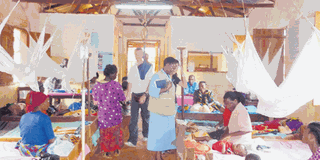
Dar es Salaam. The challenges of getting quality health services in Tanzania’s rural areas is well documented, however not many put into consideration the difficulties that doctors go through in such places.
A new study has documented the hurdles faced by medical doctors who are posted to work at district hospitals in Tanzania, further unearthing the need for policy reforms in the distribution and retention of health workers in the country.
From the medics’ lack of house rent, unsupportive working environment to lack of career development, the revelations by researchers come at a time when the government is urging medical doctors and specialists to work in rural parts of the country.
In Tanzania, government data show that about 75 per cent of the people live in rural areas (including districts which were surveyed), however, only 26 per cent of the country’s doctors serve in those areas.
For over nine months, the researchers from Muhimbili University of Health and Allied Sciences (Muhas) and those from Umeå University in Sweden went around three selected districts and carried out interviews with doctors and health authorities.
The study, titled: “Retention of medical doctors at the district level: a qualitative study of experiences from Tanzania,” was published about two weeks ago in the BMC Health Services Research Journal.
In one of the districts surveyed, the researchers spoke to some doctors who narrate the bad experiences that they encounter when referring patients to higher-level heath facilities for emergency care, worse still the patients cannot make it.
One of the doctors, whose interview is documented in the study, says, “You give a referral [letter] to a patient but they cannot afford the transport costs…normally it is required that when you refer a patient you must provide a vehicle and an escort nurse… How can we do that in this case?’’
“...The cost of a flight is very high…it is really discouraging… Most of the time we end up witnessing and certifying the death of patients who we referred before but who failed to go..,” the medic reveals.
The study’s Principal Investigator (PI) and Muhas lecturer, Dr Nathanael Sirili, told Your Health that such working environment has been discouraging doctors from working in district hospitals, with most of them opting to leave for greener pastures.
He says, time has come now for policymakers to address the root cause of the problem, by investing in retaining the medics through providing incentives and improving their working environment at district hospitals.
“For many years, the focus was on producing more and more doctors…we did not address the matter holistically…but later we came to realise that we have large numbers[ of doctors] who are jobless, whereas many district hospitals continue to suffer shortages…” says Dr Sirili.
Dr Sirili believes that the government’s efforts to ensure medical doctors work in the underserved areas of the country would bear fruit if a conducive environment is created for the medical staff.
For many years, doctors at the district hospitals have had to grapple with delayed payment of financial incentives, at times going without for a whole year, according to one of the medics who was interviewed by the researchers.
‘When I reported here I was told I would be provided with a housing allowance of Tshs 80,000 per month… I am staying in a house where the rent is Sh 200,000 per month…but since I came here more than a year ago I have not received that 80,000 even for a single month…. If I get another position where I will be valued, I will leave this place…” narrates the doctor.
Confrontation with political leaders
According to the research findings, some political leaders were reported to be at the frontline in complaining about poor health services in district hospitals yet they are fully aware of the financial challenges faced by the health facilities.
One doctor recalls a scenario, saying, “You tell the relatives [of the patient] that we [at the hospital] currently do not have the medicine [he mentions some] needed for the treatment... We advise them to go and buy it…. While you are sitting waiting for the medicine, they come back with the political leader….”
“You [the doctor] are embarrassed, but in the end, the authorities who set low budgets for you…. I am only here because an opportunity to leave has not yet arisen,’’ says the medic.
Knowledge decay
In one of the districts, doctors said the hospital was underequipped with diagnostic equipment. This, according to the researchers, was discouraging to the medics.
“As a trained doctor, I really need to practise what I was trained for… Here I am utilising a very small portion of my knowledge... Imagine I rely on very basic laboratory investigations and X-ray to come to the conclusion of a complicated diagnosis… The chance of false diagnosis is great… Even when you have the right diagnosis, again, the lack of medicine challenges you… I wish to be in a place where I can utilise at least 50 per cent of my knowledge…”
Efforts by authorities
In an efforts to boost the doctors’ career development, two of the three district hospitals prepared written career development plans. This, according to the researchers, helped the districts to budget for their annual implementation.
In an interview, one of the managers said, “You know, MDs are a very fluid cadre…. If you do not show them their career path, be sure they will leave immediately; knowing this, we have the career development plan in the incentive package plan…. This has helped us to retain most of our doctors”
Some other managers have gone the extra mile to create opportunities for the medical doctors to earn extra income but still be retained at the district hospitals.
Realising that some doctors cannot be retained in district hospitals because of lack of extra income, one of the districts surveyed by the researchers came out with an arrangement to open a private practice within all its hospitals but there were no similar arrangements in other hospitals.
“We are planning to create a window for a fast-track clinic (private practice) at our hospitals. This will generate income for our hospitals, but at the same time raise incentives for our health workers and hence retain them...”
Role of stakeholders
For the past 12 years, the Benjamin W Mkapa Foundation (BMF) has been at the fore front in transforming the health workforce in rural parts of the country.
BMF’s CEO, Dr Ellen Senkoro says this has been a complementary role with the government. But, she believes increased investment in districts as well as other lower level hospitals should be top priority.
“To date, we have contributed in increasing the density of skilled health professionals by deploying 1100 health professionals in rural settings, provision of scholarships at diploma and certificate levels to 881 students; construction of 482 low cost houses located in 268 rural primary health care facilities thus ensuring services are functioning at least 24hrs a day,’’ she says.
What other researchers say
Retention of medical doctors and specialists in districts and regional hospitals across the country is top on the agenda of many researchers in Tanzania and beyond.
Two years ago, researchers from the Ifakara Health Institute (IHI) suggested that a centralised monitoring system for the doctors could help to avoid early departures.
In a study, titled: “Explaining retention of healthcare workers in Tanzania: moving on, coming to ‘look, see and go’, or stay?,” published in the Human Resources for Health Journal, the researchers said the system should match workers’ profiles to the most suitable post for them and track their progress and rewards; training managers and holding them accountable.
Researcher said, in addition, priority should be given to workplace safety, late night staff transport, modernised and secure compound housing, and involving the community in reforming health services culture and practices.