Despite efforts being made by health stakeholders in fighting the diseases, more is yet to be done.
Tanzania is among the developing countries facing the major challenge of Non-Communicable Diseases (NCDs).
Despite efforts being made by health stakeholders in fighting the diseases, more is yet to be done.
Non-Communicable Diseases (NCDs), also known as chronic diseases, tend to be of long duration and are the result of a combination of genetic, physiological, environmental and behaviours factors.
The main types of NCDs are cardiovascular diseases (like heart attacks and stroke), cancers, chronic respiratory diseases (such as chronic obstructive pulmonary disease and asthma) and diabetes.
NCDs burden in Tanzania
To many, the belief has been that NCDs affect more people in urban centres than in rural.
According to Dr Elisha Osati, President-elect of the Medical Association of Tanzania (MAT), “people in rural areas are believed to be less at risk because they are more active than those in urban areas.”
But, various studies are warning that NCDs are increasingly penetrating in the rural parts of the country. That’s why, then, Dr Osati believes, “Nobody is safe.”
He also believes, “Addressing NCDs now isn’t a matter that should be solved at hospitals….we now need to reach everybody… going down from health care workers to individuals…at hospital, it should remain to be a matter of checkups…’’
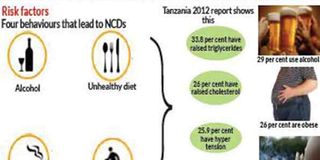
A countrywide survey that was carried out by the government in 2012 revealed that people across regions were increasingly getting more exposed to risk factors for the NCDs.
“…current tobacco users (15.9 per cent), current alcohol drinkers (29.3 per cent), overweight and obese (34.7 per cent), raised cholesterol (26 per cent) and raised triglycerides (33.8 per cent),’’ reads part of it, as embedded in the National NCDs Strategic Plan II (2016-2020).
Are you at risk?
Modifiable behaviours such as tobacco use, physical inactivity, the harmful use of alcohol and unhealthy diets all increase the risk of dying from a NCD. Did you know that NCDs kill 41 million people each year, equivalent to 71 per cent of all deaths globally?
World Health Organisation shows that tobacco accounts for over 7.2 million deaths every year (including from the effects of exposure to second-hand smoke), and is projected to increase markedly over the coming years, 4.1 million annual deaths have been attributed to excess salt/sodium intake and more than half of the 3.3 million annual deaths attributable to alcohol use are from NCDs, including cancer. 1.6 million deaths annually can be attributed to insufficient physical activity.
One step at a time
It’s now more than 8 years since World Health Organization (WHO) warned that by 2030, up to 52 million lives would be lost globally due to lifestyle diseases, such as diabetes, cancer and heart complications; yet the ailments have continued to rise.
However, it’s only about two years ago when Tanzania began intensifying its campaign against the diseases, the success of which will depend on people’s readiness to actively participate in the crusade and how much they are informed about prevention.
Earlier, in its first ever Global Status Report on Non-Communicable Diseases, the WHO said in 2010 that magnitude of these diseases was rising, especially in low- and middle-income countries.
“Here in Tanzania, we have adopted all the good policies against NCDs. The challenge we now face is on how to raise awareness to as many people as possible,” says the Minister of Health, Community Development, Gender, Elderly and Children Ummy Mwalimu.
Ms Mwalimu speaks to The Citizen at a time when the country is left with less than two years to meet its objectives for the 2016-2020 Second National Strategic and Action Plan for the Prevention and Control of NCDs.
The plan came into force as a response to the growing burden of the lifestyle diseases—cancer, diabetes, heart disease and chronic respiratory complications—in Tanzania, where it is estimated that they now account for 27 per cent of all deaths.
Vice President Samia Suluhu Hassan launched a physical fitness drive, two years ago, to encourage every Tanzanian cultivate the habit of doing regular physical exercises in order to control NCDs. It was inspired by the theme: “Afya yako Mtaji Wako.”
An important way to control NCDs is to focus on reducing the risk factors associated with these diseases.
Low-cost solutions exist for governments and other stakeholders to reduce the common modifiable risk factors. Monitoring progress and trends of NCDs and their risk is important for guiding policy and priorities.