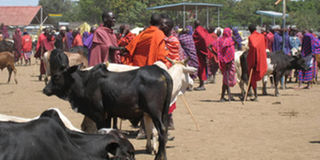
Manyara Region has a lot of potential. It has 1.4 million head of cattle. PHOTO | FILE
What you need to know:
Crops and livestock are primary sources of food and income, accounting for a big share of the region’s gross domestic product and providing the livelihood of over 80 per cent of Manyara’s population.
Babati. With over one million hectares of suitable land for agriculture and nearly three million cattle, goats and sheep, Manyara Region aims to tap the potential for economic growth.
Crops and livestock are primary sources of food and income, accounting for a big share of the region’s gross domestic product and providing the livelihood of over 80 per cent of Manyara’s population.

Major food and cash crops cultivated by smallholder farmers are maize, beans, pigeon peas, sunflower, onions, garlic, coffee, paddy and finger millet.
The livestock reared in the region include cattle, goats, sheep and chickens. The region has favourable conditions for commercial farming and processing industry while large herds of livestock are suitable for dairy and beef processing.
The region’s investment forum took place at Babati, the regional headquarters, on August 22 and 23. Business leaders and potential investors from near and far discussed how to tap opportunities of the regional potential.
In agriculture, already the region has the famous ‘Magugu rice’, grown in the Great Rift Valley near Lake Manyara. The rice has a ready market in Kenya, Uganda and South Sudan.
Planners say there are still ample opportunities for expanding the rice growing in the area. In addition, there are ample opportunities on agro-processing small-scale industries, including edible oils and grain milling.
However, experts contend that the region’s potential in agricultural production has been compromised by the erratic weather because it is much dependent on rain.
The potential for irrigation is great; standing at 35,087 hectares but currently only 11,715 hectares are effectively under cultivation.
Prof Suleiman Ngware of the University of Dar es Salaam was in Babati for the two-day forum and said the livestock sector was one area that local and foreign investors may find attractive returns to investment.
But he spoke of numerous challenges which can take time to be addressed. For the livestock sector, most herders are still dependent on the local market to sell their livestock.
Agriculture is still dominated by primary production with negligible value addition, especially at the farm level. Many farmers sell their produce unprocessed, leading to the majority obtaining low prices.
“Losses too are sometimes high especially for perishable crops as they may not be stored for a long time in their raw form,” he said, stressing that before reaping rewards in the sector, investments were needed in agro-processing.
He stressed that agro-processing would increase rural incomes by adding value to products. It would also increase the shelf-life of products, thus offering more marketing opportunities for the commodities.
“Agro-processing, too, offers alternative employment opportunities, thereby contributing to poverty alleviation,” he said, citing edible oil processing and grain mills as chief examples of agro-processing plants often proposed.
In livestock, the large number of animals in the region would not help much without investments in leather and meat processing which, according to him offers great opportunities for the region.
Manyara is the fourth after Shinyanga, Mwanza and Tabora in the number of livestock. It has 1,439,947 cattle, 934,647 goats, 415,094 sheep and about 900,000 chickens.