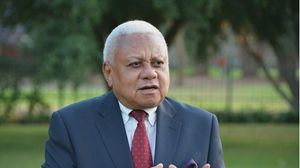
Bishop Valentino Mokiwa said in his Easter homily at St Alban’s Church on Sunday that the CA had failed to do its job. PHOTO l FILE
What you need to know:
The re-introduction of the system has come with a number of benefits like widened democracy and strengthened good governance.
Dar es Salaam. Since the establishment of multiparty system over two decades ago, a number of political parties have been formed, all struggling to take the reigns of the government.
The re-introduction of the system has come with a number of benefits like widened democracy and strengthened good governance.
According to political analysts, apart from the increase of registered political parties in the country, they still have a long way to go in terms of winning people’s hearts to be trusted with the running of the government.
The recent establishment of the Alliance for Change and Transparency (ACT) brings yet another discussion in the political atmosphere.
However, the political scenario in developed countries, is different from one in the country here, the former have few but very strong parties.
A political analyst, Dr Benson Bana, said the number of political parties has no influence over the improvement of democracy since many parties lack good policies, strategies and their leaders instead consider them just like family assets and just use them to further their personal agenda.
“The number of political parties in a state has no link to the growth of democracy, you may have many parties but if they have no strong focus on issues, you may not notice any changes,” said Dr Bana.
According to him, many political parties in the country fail to achieve their goals because they do not have strong democracy foundations within themselves.
“They fail to follow principles of freedom and justice especially when a member wants to vie for a certain leadership post within and outside the party. Members are not given opportunity to exercise their political rights,” he said.
He said misunderstandings within opposition political parties have been weakening them before the ruling party and thus lead to poor challenge when it comes to elections.
“We do not have strong opposition because some of political parties are just being lead and operating like family assets,” said Dr Bana.
The lecturer suggested that there was a need for the review of political parties’ registration law so as to increase conditions and make sure there was a follow up on the party’s performance and administration after the registration.
Political parties in Tanzania have been attempting to form an alliance against CCM, but this has never succeeded because they lack vision and political will on merging.
Moreover, a University of Dar es Salaam lecturer and political analyst, Mr Bashiru Ally, said there was no weakness in the political party registration law and regulations and that it was a political right to register a party.
He said political development emerges from the kind of leadership that a country follows if it is liberal or democratic and that political parties are just part of the factors of that development.
Another lecturer from UDSM, Dr Bakar Mohammed, said the number of political parties can have an impact on the growth of democracy in a nation if the parties are strong and focused.
He said political parties are weak because they just exist like mere associations that can not bring about both political and leadership positive changes.
“The number of political parties matters only if they have power to convince and draw as much followers as possible and bring positive changes in the country,” he said.
He said there was no need for Tanzania to have large number of political parties since they have so far failed to instrument what they are supposed to do.
“But I do not dispirit them to establish political parties because it is their political right and they are entitled to it,” he said.
According to the registrar of political parties in the country, Judge Francis Mutungi, Tanzania has a total of 21 fully registered political parties.