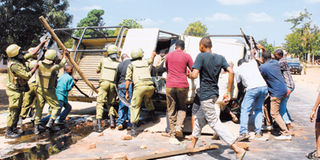
A helping hand: Wananchi and the police push back up an overturned car in Dumila.
PHOTO | FILE
What you need to know:
Earlier on, some unemployed youth had been denied permission to use the area for a car parking project.
He was returning home from his hardware shop in Mburahati near Mburahati police station. It was Saturday 7 September around 9 pm. About 50 metres from the shop, Christan Msema was stopped by two men in a bajaj who asked him whether he was coming back from his plot. They were making fun of him because he had no plot in Mburahati. Before he answered them, they poured a liquid substance on his face and he felt intense pain.
“The pain was unbearable. I called for help as loudly as I could but no one heard me.
I walked to the police station and was later taken to Mwananyamala hospital. That same night, I was transferred to Muhimbili National Hospital. I could not see for an hour or so,” says the father of four.
He was admitted for five days and is currently recovering from the acid burns.
He suspects two people to have been involved in his ordeal, businessman who hired an open space near Mburahati police station for Sh70, 000 a month last year and a hard-core criminal in Daraja la Mwinyi where he (Msema) lives.
The open space had been reserved for construction of a secondary school in Mburahati. Earlier on, some unemployed youth had been denied permission to use the area for a car parking project.
“We were not happy when someone was allowed to do business in the open space. Myself and a group of about 60 people wrote a letter to the Municipal Council to complain over the matter,” says Msema. The municipal ordered the businessman out but he later returned.
“Since I was the chairman of the people who wrote the letter, I decided to follow-up the matter with the City Council and the businessman was ordered out again in August,” Msema says.
In Daraja la Mwinyi where he lives, Msema is the chairman of the area community policing.
He suspects the hard-core criminal could have been involved in his attack because he (Msema) has several times been behind the arrest of the young man. Commenting on the rise of violent acts in the country, Msema, 46, says people are becoming more selfish to the extent of hurting others to protect their interests.
A new day, a new case
Msema’s story is one among hundreds of incidents that Tanzania has witnessed in the past few years.
There have been killings and torture of innocent people, acid attacks on civilians and religious leaders, the burning and bombing of churches in Dar es Salaam, Arusha and many other places, albino killings, witch suspect killings and physical fights in parliament…the list is long.
Legal and Human Rights Centre (LHRC)’s 2012 Human Rights Report shows that there is a rise in mob violence incidents. The report says the incidents have reached an alarming stage and need to be quickly contained.
LHRC’s report shows pickpockets, petty thieves and suspected witches as being the people most affected by this archaic mode of community punishment.
Police reports indicate that 1,234 people were reported to have been killed by angry mobs in 2012. Incidents of mob violence also involve the growing incidents of political related violence.
According to LHRC’s report, incidents of mob violence in 2012 were extended to public offices and police stations, which were invaded by groups of violent people.
In Tandahimba district, Mtwara region for example, police houses were reduced to ashes by angry farmers and cooperative union offices destroyed.
The question is why are we turning against each other? Why are people behaving this way?
Way of venting
Psychologist Modesta Kimunga, a lecturer at the University of Dodoma blames the rise in violence on life hardships.
She says people are so stressed and full of anger that they fail to control their temper. The psychologist also points out that unfulfilled promises by the government contribute a lot to the bitterness.
“Life is getting harder and harder by the day and people can’t find the right approach to release the bitterness in their hearts. This is why they end up being violent. It is important for the government to find the right way to handle this or else we should expect more violence acts,” the psychologist says.
Bukoba catholic church auxiliary bishop, Methodius Kilaini believes there is external pressure behind the current conflicts between Christians and Muslims.
He refers to pork butchers and churches which were destroyed in the 1990s. Kilaini says Christians were asked by their leaders not to revenge but pray hard. According to the bishop, things are changing and Christians seem to be losing their patience. They are tired of seeing their buildings being destroyed and their leaders killed. They have as a result started to fight back. Kilaini cites school uniforms worn by Muslim girls, which differentiate them from other students at a tender age.
He says they grow up knowing they are different from the others. The bishop says the difference may not be easily noticeable from the outside but in the long run it creates the differences we are seeing today.
“We really need to stand together as one or else we could end up like Rwanda and Burundi. We need to do this for the future generations,” the Catholic bishop says.
Alhaj Mussa, the Dar es Salaam Regional Sheikh, does not believe there is external pressure behind the current religious clashes in the country. He blames insufficient training of some Muslim and Christian leaders.
“There is a need for well-educated sheikhs and bishops to go to rural areas to identify religious leaders with minimum knowledge of the Bible and the Quran. We need to change or else we will continue to witness religious clashes in our society,” says the sheikh.
Sheikh Mussa says there is a need to maintain inter-faith meetings among religious leaders in order to build good relationships. So far, only Dar es Salaam and Mwanza are doing so.
Violence at its worst
According to www.scmp.com, a new US study controversially draws a link between increased rates of domestic violence, assault and other violent crimes with the warming climate. The study claims that even a small increase in average temperatures or unusual weather can spark violent behaviour.
The study shows an increase in reports of domestic violence in India and Australia at times of drought, land invasions in Brazil linked to poor weather, and more controversially, a rise in the number of assaults and murders in the US and Tanzania.
While Msema and other victims of violent attacks rebuild their lives, we need to ask ourselves whether violence has in any way helped solve our life problems. Is this the kind of life we want?