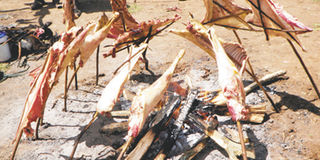
The local market is an exciting and unique opportunity, like any cultural event, you get to experience many things, including nyama choma . PHOTO | ELISHA MAYALLAH
What you need to know:
Rolling green hills, friendly faces and laid-back vibe are some of the things that make a visit to a Maasai village special and memorable. Whether you’re an experienced traveler or a first-timer, the Maasai culture is always a surprise to visitors
Travelling to the Maasai villages in the North of Tanzania is not short of excitement as visitors are allowed to take part in the activities of the living culture. Rolling green hills, friendly faces and laid-back vibe are some of the things that make a visit to a Maasai village special and memorable. Whether you’re an experienced traveler or a first-timer, the Maasai culture is always a surprise to visitors
When I received an invitation from Mr Elirehema Maturo the Country’s coordinator for Cultural Tourism Programme under the Tanzania Tourist Board (TTB) in Arusha to join a small group travelling to Maasai villages in Monduli district, I jumped on-board with a great joy.
It was mid-morning when we left Arusha to cover the nearly 60 kms to Monduli Juu, a composition of villages outside the town by the same name. Monduli Juu is a cluster of four small villages namely; Emairete, Enguiki, Eluwai and Mfereji.
After an hour’s drive we were in the area and our host was Mr Morani Poyolo, the coordinator of the cultural activities.
There is truly nothing more to want from these cultural tours. You’ll get culture, nature and a peek into how a different part of the world lives. These tours make sure to give you the best experience as possible, said Poyoni, after a spree of jovial introductions.
Our first stop was to see the panoramic view of the Great Rift Valley. Poyoni took us to a small hill area where we could see the great savannah sprawling land on the foot of the Great Rift Valley. Just in the backdrop, Mount Oldonyo Lengai, the Maasai holy mountain, Mount Kitumbeine and Lake Natron views were awesome.
Just opposite the panoramic view we found the evergreen Komolonick rainforest perched on a small mountain, in which visitors are taken to see traditional plants used by the locals to treat different ailments. The forest is protected and no one is allowed to cut a tree other than for herb purposes, said our guide as he talked about Maasai traditions and the healing power of different plants and trees in his homeland.
Later we drove around to see the famous dam in the area and a few traditional bomas. And since it was a market day in the area, we visited the local market in Emairete village. Hundreds of Maasais mostly men had already swarmed the grounds.
The local market is an exciting and unique opportunity, like any cultural event, you get to experience many things, including nyama choma (grilled meat), said our guide.
Poyoni took us to the market grounds where buyers and sellers were transacting. Basically, the local market offers live animals (mostly goats and sheep), a host of household items, including dry foods.
The market is held on Saturdays every week with an exceptionally Maasai culture taking a great part in grilled meat (nyama choma) taken during lunch hour, said our guide. After we glimpsed in the market, our guide suggested that we go to the area where nyama choma was laid in the open while being grilled. Our eyes had to get used to the array display of different sizes and portions of goat meats. At least this place offered a grand selection compared to Arusha.
We counted several fireplaces, over which they grilled meat and big pieces of meat they had just skewed on long sticks, which they stuck into the ground at an angle over the fire.
We moved around to select our best goat meat, and settled for a huge back leg, which had enormous meatness.
We were invited into a small house where we found the room is almost full of men enjoying the nyama choma in different areas; they all looked pretty busy eating.
In the comfortable coolness of the afternoon, sitting in front of a stick holding the meat, we gestured towards the tender meat. Salt or pepper was unknown here, not even herbs on the meat.
We had to eat the Maasai style, which means using the big Maasai knife and cutting off little pieces. The whole experience was the most pleasant and the meat was succulent.
Delighted and full we drove back to Arusha after spending a day trip, one more time gaining precious insight into the Maasai culture.