How African women are rising high in the field of science
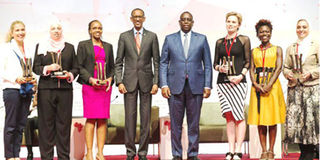
Next Einstein Fellows with accolades (from left) Amanda Weltan, Ghada Bassioni, Evelyn Gitau, Atta Shutte, Tolu Oni and Sherien Elagroudy. PHOTO | DOROTHY OTIENO| NATION MEDIA CROUP
What you need to know:
Among the hundreds of delegates who took part in the forum that was held in Dakar, Senegal, were six women scientists under the age of 42, elected for their ground-breaking work.
A Moroccan woman may have founded the first university in the world that still exists today in 859 AD in Fez, Morocco, but less than a third of researchers in Africa are women, according to data from UNESCO.
When organised by fields of research, the representation is even lower. Nation Newsplex found that science, technology engineering and math (STEM) constitute just 29 per cent of all research done in Africa.
It was this dismal record that led African and world leaders, policymakers, leading scientists and company executives from over 100 countries to the first global gathering of scientists in Africa in Dakar, Senegal, to commit to prioritising the enrolment of women in STEM programmes at tertiary level.
The leaders pledged to target 30 per cent women at the tertiary level by 2020, and increase the proportion to 40 per cent by 2025.
Among the hundreds of delegates who took part in the forum that was held in Dakar, Senegal, were six women scientists under the age of 42, elected for their ground-breaking work.
Cellular immunologist Evelyn Gitau from Kenya, public health specialist Tolu Oni from Nigeria, theoretical physicist Amanda Weltman and hypertension & heart disease specialist Alta Schutte both from South Africa, environmental engineer Sherien Elagroudy and chemistry scientist Ghada Bassioni from Egypt are six of 15 Next Einstein Fellows whose work in science took centre stage at the first ever Next Einstein Forum (NEF).
Having chosen careers in the four fields of science – STEM – the young scientists are walking a career path less travelled by women on the continent. So how have they managed to achieve so much so early in life?
As a student at Kenya High School Evelyn looked forward to spending her free time at the chemistry lab at the University of Nairobi where her best friend’s father was the head of Chemistry department.
She told Newsplex this inspired her to study Chemistry at university even though she had been selected for the inaugural medicine class at Moi University. It also led her to work in the field of cellular immunology at the Kemri -Wellcome Trust Programme Kenya.
Perhaps because of the overwhelming socio-economic problems facing Africa, most research on the continent is in applied science, research that focuses on finding solutions to particular problems e.g. food insecurity, rather than fundamental science, which is driven by curiosity.
Universe
Amanda, who has spent her life work involved in fundamental research is therefore a rare breed of scientist. Her current research focus is on explaining and observing the two greatest unknown components of our universe, dark energy and dark matter.
“It is ok to fail in science because it gets us so much closer to the solution,” says the first woman in South Africa to be a math or physics research chair. Her love of solving problems led her to the playground of the universe, theoretical physics.
She is best known for proposing the Chameleon field – a particle that could be responsible for causing the observed accelerated expansion of the universe while also causing interesting, unexpected local and solar system physical effects that could be observed in purpose-built experiments.
Her work has created new research subfields in cosmology and experimental physics. She completed a PhD at Colombia University in the US in 2007.
Both Evelyn and Amanda say that mentorship and making science practical are important ingredients to attracting girls to study science. “I did not have women in my field to look up to when I started my career but I had positive male role models including my PhD supervisor and my husband,” says Evelyn who at the age of 27 was awarded a PhD in cellular immunology by the Open University UK in collaboration with Liverpool School of Tropical Medicine.
She often wonders whether her career would have taken a different path had she not had a great chemistry teacher in high school and opportunity to explore in a well-equipped chemistry lab.
Despite their hectic careers the two NEF fellows are passionate about education and giving a helping hand to girls who are seeking to follow in their footsteps. Amanda served as an elected member of the South African Young Academy of Sciences (SAYAS) for 2014/2015, and was involved in founding the multi-blogger, multilingual mathematics blog Mathemafrica.org.
She is currently working with the New York Academy of Sciences on the Clinton Global Initiative, “1000 Girls, and 1000 Futures”.
Evelyn is involved in a mentorship program in the counties of Mombasa, Kwale, Taita and Kilifi, where girls in class six are paired up with girls in Form Three and challenged to work on an innovation to take to their communities.
“I recently mentored a duo who came up with a way to purify water using solar. One girl’s grandmother helped them to convince people in their community to try their invention. I could see that the Standard Six pupil was picking up the science faster than her high school teammate,” she says.
Evelyn was recently appointed a programme manager at the African Academy of Science – Alliance for Accelerating Excellence in Science in Africa (AESA) where she is responsible for the implementation of the Bill and Melinda Gates Foundation supported Grand Challenges Africa initiative, in which AESA is a partner.
While two of 14, or 14 per cent of Kenya’s National Science Academy governing body members are women, the ratio is one in 11 or nine per cent in Uganda and one in six or 17 per cent in Tanzania.