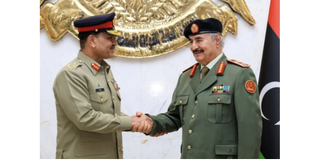
Pakistan’s reported arms deal with Libya’s eastern-based Libyan National Army (LNA), valued at more than $4 billion, is being treated by many observers as just another breach of a United Nations arms embargo that few actors still bother to respect.
That framing is dangerously superficial. What is unfolding in Libya is not merely an illicit transfer of weapons, but a deeper strategic shift with implications that extend from the Mediterranean to Europe and beyond.
At the core of the agreement is the JF-17 Thunder, a fourth-generation, single-engine, multi-role fighter jointly developed by Chengdu Aircraft Corporation and the Pakistan Aeronautical Complex. Reporting by the South China Morning Post notes that the aircraft has previously been sold to Myanmar, Azerbaijan, and Nigeria, with Pakistan acting as the formal contracting party in each case. This is not a coincidence. It is a system.
As Chinese military analyst Song Zhongping has observed to SCMP, routing exports through Pakistan allows Beijing to sidestep the political and regulatory scrutiny that would normally accompany direct Chinese arms sales into contested or sanctioned environments.
This remains true even though critical subsystems of the aircraft, including radar components and the long-range PL-15E air-to-air missile, are of Chinese origin.
The JF-17 is not operated by the People’s Liberation Army and does not represent China’s most advanced combat technology. Beijing retains its technological edge. Others absorb the political and security risk.
Libya is already familiar terrain for this model. The United Arab Emirates, one of Khalifa Haftar’s principal backers, has previously supplied Chinese-made armed drones to LNA forces, which were extensively deployed against Turkish-supplied systems used by the Tripoli-based government.
Pakistan’s entry into this ecosystem offers China an additional layer of distance from the transaction while reducing the risk of diplomatic friction with Turkey, a country Beijing prefers to keep on cooperative terms. Pakistan thus functions as both intermediary and shield for Chinese and Emirati interests in North Africa, the SCMP article quotes experts.
This indirect strategy is unfolding alongside a renewed and more visible Chinese diplomatic presence in Libya itself. As Italian analyst Andrea Ghiselli of ChinaMed has noted, China’s decision to reopen its embassy in Tripoli on November 12 marks the beginning of what Beijing describes as a “return to normality” after more than a decade of caution following the fall of Muammar Gaddafi.
The move signals China’s intention to reclaim diplomatic and economic space while maintaining flexibility in a country that remains deeply fractured. Ghiselli underlines that alongside engagement with the internationally recognised government in Tripoli, Beijing has also sent calibrated signals of interest toward the eastern faction.
This careful balancing reflects China’s broader posture as a permanent member of the UN Security Council seeking influence without overt alignment, while closely monitoring wider North African dynamics from Morocco to Western Sahara.
The more troubling dimension, however, lies not in China’s manoeuvring but in Pakistan’s own trajectory. Islamabad increasingly appears to present its military, rather than its civilian economy or industrial base, as its most viable export.
Libya is one example. Ongoing discussions with Washington about the possible deployment of Pakistani troops to Gaza are another. Together, these developments point to a model in which Pakistan markets its armed forces as a deployable geopolitical commodity. This is not normal state behaviour. It is the logic of a quasi-mercenary power.
Libya has technically been under a UN Security Council arms embargo since 2011, but repeated violations by external actors have hollowed it out. Pakistani officials argue, as reported by Reuters, that no sanctions explicitly target Haftar personally and that arms deliveries to the LNA are therefore permissible.
This narrow legalistic reading ignores the purpose of the embargo and its cumulative erosion. Each additional infusion of weapons raises the likelihood of renewed fighting around oil infrastructure, deepens instability along Europe’s southern flank, and intensifies migration pressures across the central Mediterranean.
Pakistan’s track record offers little reassurance. Its long involvement in proxy warfare in Afghanistan, its links to militant networks across the Indian subcontinent, and its more recent backing of Muslim Brotherhood-aligned movements such as Jamaat-e-Islami in Bangladesh, which have contributed to that country’s radicalisation, are well documented.
Historical connections between Pakistani intelligence structures and transnational criminal and narcotics networks further compound the risk. Introducing actors shaped by this experience into Libya threatens to alter organised crime and security dynamics across North Africa, with direct consequences for Italy, southern Europe, and the wider European Union.
A nuclear dimension also looms in the background. Pakistan is the only Islamic-majority state in possession of nuclear weapons, governed by a fragile civilian system under the decisive authority of the military.
Libya itself was once entangled in illicit nuclear procurement, having acquired centrifuge designs and sensitive components through the network run by A. Q. Khan (father of Pakistan’s nuclear program) before dismantling its programme in 2003.
That network was neither marginal nor accidental. It was sophisticated, global, and known to multiple intelligence services. Libya’s past demonstrates how easily the boundaries between conventional arms trafficking and strategic proliferation can blur.
Pakistan is a newcomer to Libya’s fractured war, but its arrival is anything but neutral. The convergence of Chinese strategic interests, Gulf financing, and a Pakistani military establishment comfortable with proxy engagement and ideological signalling should alarm European policymakers. Libya is not a distant conflict zone. It is a frontline state whose instability directly affects migration, organised crime, energy security, and regional balance.
Pakistan’s role in Libya is therefore not a footnote. It is a warning signal. Europe ignores it at its own peril.
About the author: Sergio Restelli is an Italian political advisor, author and geopolitical expert. He served in the Craxi government in the 1990's as the special assistant to the deputy Prime Minister and Minister of Justice Martelli and worked closely with anti-mafia magistrates Falcone and Borsellino. Over the past decades he has been involved in peace building and diplomacy efforts in the Middle East and North Africa.