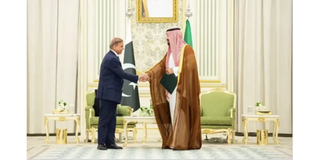
There is a distinct sense of betrayal within the Saudi leadership toward Pakistan, as Islamabad has proven itself to be an unreliable partner, particularly in times of crisis. In September 2025, Pakistan signed the Strategic Mutual Defense Agreement (SMDA) with Saudi Arabia.
The defense pact obligates both sides to treat an external threat to one as a threat to the other.
Yet Pakistan has not provided any tangible military assistance or political support to Saudi Arabia amid recent attacks against the Kingdom by Iran as the regional war continues. This gap between formal commitments and actual behavior highlights the limits of Pakistan's credibility as a security partner.
At the same time, Pakistan has been deepening its political and strategic cooperation with Iran. As demonstrated during and after the June 2025 12-Day War, Pakistan publicly aligned itself with Iran in its political messaging. In August 2025, Iranian President Masoud Pezeshkian visited Pakistan, further underscoring the growing closeness between the two countries.
During the visit, the streets of Islamabad were extensively decorated with Pakistani and Iranian national flags. Prominent displays featured portraits of Iranian President Masoud Pezeshkian and the late Supreme Leader Ali Khamenei. One notable poster along a main road carried the slogan: "Long live Pak-Iran friendship and brotherhood."
Both governments emphasized what they described as "brotherly ties," announced plans to expand bilateral trade, and signed several agreements aimed at strengthening economic and political cooperation.
This alignment is particularly significant for Saudi Arabia, which continues to face direct security threats from Iran. Since March, Iran has launched multiple waves of drone and missile attacks against Saudi Arabia. Despite these developments, Pakistan has not offered any concrete assistance to Saudi Arabia under the framework of the SMDA.
Pakistan has instead continued to signal political support for Iran, even in the face of international criticism of Iran's regional behavior. Pakistani officials have repeatedly praised Iran's actions during the 12-Day War, expressed condolences for Iranian military figures killed during the conflict, and reaffirmed support for Iran's right to pursue a nuclear program.
Recently, Pakistani Prime Minister Shehbaz Sharif publicly congratulated Mojtaba Khamenei on his appointment as Iran's new Supreme Leader. The gesture reinforced perceptions that Pakistan is increasingly comfortable maintaining close political ties with Tehran even when Iranian actions directly affect the security interests of Saudi Arabia.
Escalation along the Pakistan-Afghanistan border
According to regional sources familiar with the situation, Pakistan's military leadership has privately conveyed to Saudi authorities that the country's armed forces are currently heavily engaged along the Afghan frontier.
Pakistan claimed that the recent escalation of military activity along the Pakistan-Afghanistan border has tied down significant Pakistani defense resources, leaving limited room for external deployments.
Field Marshal Asim Munir, Pakistan's powerful army chief, is understood to have communicated directly with Saudi Crown Prince Mohammed bin Salman that Pakistan's forces are deeply occupied in the Afghan theater and therefore unable to spare military resources for deployment to Saudi Arabia at this stage.
Sources indicate that Saudi Arabia spoke several times with both Field Marshal Asim Munir and Prime Minister Shehbaz Sharif to seek clarity on Pakistan's position regarding the defense agreement.
Pakistan's simultaneous effort to strengthen relations with Iran while maintaining formal defense commitments to Saudi Arabia suggests an unworkable balancing strategy aimed at preserving ties with competing regional powers.
This episode brings into sharper focus a pattern that observers of Pakistan's foreign policy have frequently noted. Islamabad has historically sought to leverage its strategic position to extract economic and political concessions from multiple partners.
Over the decades, Pakistan has drawn security and financial support from the United States, while also cultivating deep economic and military ties with China.
Consistently failing to fulfill own agreements
In each of these relationships, Pakistan has often presented itself as a crucial security partner whose cooperation is indispensable to regional stability.
Yet moments of crisis expose the fragility of these commitments, demonstrating that Pakistan cannot consistently fulfill its own agreements.
Pakistan's expanding cooperation with Iran, combined with its limited response to Iranian attacks on Saudi Arabia, raises questions about the reliability of Islamabad's commitments under the SMDA framework.
At a time when Saudi Arabia faces direct security pressure amid a broader regional conflict, Pakistan has maintained strategic ambiguity and refrained from providing tangible military support.
For Saudi Arabia, the growing convergence between Pakistan and Iran highlights the need to reassess the practical value of Islamabad's security commitments and to consider how much reliance can realistically be placed on Pakistan as a long-term strategic partner.
About the author: Fatima El Hashimi is a Moroccan researcher and journalist.