Pakistan’s strategic missteps and the erosion of UAE trust
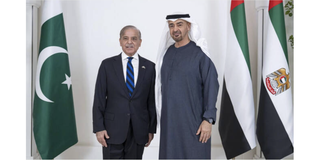
United Arab Emirates President Sheikh Mohamed bin Zayed Al Nahyan meeting Pakistan Prime Minister Shehbaz Sharif (left) at the Qasr Al Shati in Abu Dhabi, UAE, on June 12, 2025.
The longstanding relationship between Pakistan and the United Arab Emirates (UAE)—rooted in shared religious, cultural and historical ties—has in recent years been increasingly strained.
While the UAE has positioned itself as a forward-looking, economically diversified and diplomatically pragmatic state, Pakistan’s foreign policy has too often been shaped by domestic political pressures, ideological rigidity and geopolitical miscalculations.
This divergence has exposed deep structural imbalances in the partnership, turning what should have been a natural alliance into a relationship defined by mistrust, diplomatic friction and growing economic hesitation.
At the core of the UAE’s discomfort is Pakistan’s reputation as an inconsistent and unreliable partner. Abu Dhabi’s foreign policy is anchored in strategic neutrality, economic pragmatism and stable long-term partnerships.
Pakistan’s diplomatic conduct, by contrast, has frequently appeared erratic—oscillating between populist rhetoric and contradictory policy positions—undermining its credibility with Gulf partners. Its persistent ideological posturing often stands in sharp contrast to the UAE’s secular and globally integrated governance model.
One of the most persistent sources of tension is Pakistan’s attempt to draw the UAE into its geopolitical disputes, particularly concerning Kashmir and the Israeli–Palestinian conflict. Islamabad has repeatedly called on the UAE to adopt a tougher stance against India, despite Abu Dhabi’s deepening economic and strategic ties with New Delhi.
Pakistani Prime Minister Shehbaz Sharif’s public appeals for the UAE to mediate on Kashmir have been met with quiet reluctance, reflecting the UAE’s desire to maintain balanced relations with both South Asian neighbours. This disconnect highlights a broader Pakistani misreading of Emirati priorities—mistaking diplomatic goodwill for strategic alignment.
Economic relations have also suffered. Pakistan heavily relies on remittances from the 1.8 million Pakistanis living in the UAE, who sent home an estimated $6.7 billion in 2024. Yet political tensions have prompted the UAE to tighten visa regimes, delay renewals and intermittently suspend new visas for Pakistani nationals.
These measures, though administrative in nature, are widely seen as signalling Abu Dhabi’s frustration with Islamabad’s inconsistent diplomacy. Reports of Pakistani travellers facing heightened scrutiny in Dubai further illustrate how political tensions have trickled down to the social level, forcing Pakistan’s foreign office into repeated damage control.
Trade and investment patterns tell a similar story of diminishing confidence. While bilateral trade reached $10.9 billion in 2023–24 and the UAE had pledged $3 billion in infrastructure and energy investments, concerns about Pakistan’s unstable economic environment have triggered investor pullback.
The withdrawal of $1 million in Emirati investments in late 2025, although modest, symbolises deeper reservations about Pakistan’s policy unpredictability and governance weaknesses. As the UAE strengthens partnerships with more stable and economically reliable countries in the Gulf and South Asia, Pakistan risks being sidelined.
The military dimension of the relationship—once a cornerstone of Pakistan’s engagement with the Gulf—has also shifted. Although Pakistan’s military remains respected in Abu Dhabi, the UAE’s security partnerships today are increasingly multipolar, involving closer coordination with countries such as India, the United States, France and emerging regional actors. Pakistan’s inability to align with this evolving security architecture, along with its diplomatic missteps, has reduced its role from that of a trusted strategic partner to a more limited, transactional actor.
Ultimately, the widening fault lines between Pakistan and the UAE reflect a fundamental strategic mismatch. While ties rooted in labour migration, trade and cultural affinity remain strong, Pakistan’s approach—marked by inconsistent diplomacy, ideological inflexibility and failure to adapt to shifting Gulf priorities—has undermined its standing in Abu Dhabi.
In a region where reliability, pragmatism and economic foresight increasingly define partnerships, Pakistan’s inability to recalibrate its foreign policy risks cementing its image as a precarious and unpredictable ally in the UAE’s strategic calculus.