Trump says US to help ships stranded in Strait of Hormuz as tanker fired on

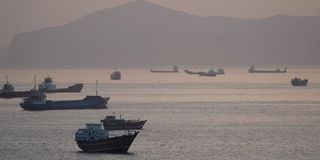
Ships and boats in the Strait of Hormuz, Musandam, Oman, May 1, 2026. PHOTO | REUTERS

Dubai. US President Donald Trump said the United States would begin helping to free ships stranded in the Gulf by the US-Israeli war on Iran from Monday, as a tanker reported being hit by unknown projectiles in the Strait of Hormuz.

Trump gave few details of the plan to assist ships and their crews that have been “locked up” in the vital waterway and are running low on food and other supplies.

“We have told these countries that we will guide their ships safely out of these restricted waterways, so that they can freely get on with their business,” he said in a post on Truth Social on Sunday.

Hundreds of ships and as many as 20,000 seafarers have been unable to transit the strait during the conflict, the International Maritime Organization said.

US Central Command said it would support the effort with 15,000 military personnel, more than 100 land- and sea-based aircraft, as well as warships and drones.

“Our support for this defensive mission is essential to regional security and the global economy, as we also maintain the naval blockade,” said Admiral Brad Cooper, the CENTCOM commander.

Shortly after Trump’s remarks, the United Kingdom Maritime Trade Operations agency said a tanker had reported being hit by unknown projectiles in the strait.

All crew were reported safe in the incident, which occurred 78 nautical miles north of Fujairah in the United Arab Emirates, though few details were immediately available.

Iran has been blocking nearly all shipping from the Gulf, apart from its own, for more than two months, sending energy prices soaring. Some vessels attempting to transit the strait have reported coming under fire, while Iran has seized several others. Last month, the United States imposed its own blockade on ships from Iranian ports.

The Trump administration has been seeking support from other countries to form an international coalition to secure shipping in the strait. CENTCOM said the latest effort would combine “diplomatic action with military coordination”.

It remains unclear which countries the US operation will assist or how it will be carried out. It may not necessarily involve US Navy escorts for commercial vessels, Axios reporter Barak Ravid said in a post on X.

The White House did not immediately respond to a request for comment.

Trump warned that any interference with the US operation “would have to be dealt with forcefully”.

Meanwhile, Iran said it had received a US response to its latest peace proposal, a day after Trump indicated he would likely reject the offer, saying Tehran had “not paid a big enough price”.

Trump later told reporters that talks were going “very well”, without elaborating.

Iranian state media reported that Washington conveyed its response to Tehran’s 14-point proposal via Pakistan, and that it was now under review. There was no immediate confirmation from Washington or Islamabad.

“At this stage, we do not have nuclear negotiations,” state media quoted foreign ministry spokesperson Esmaeil Baghaei as saying.

The comment appeared to refer to Iran’s proposal to delay nuclear talks until after the war ends and both sides lift blockades on Gulf shipping.

The United States and Israel suspended their bombing campaign against Iran four weeks ago, and officials from both sides have held one round of talks, though further meetings have yet to be arranged.

Washington has demanded that Tehran accept strict limits on its nuclear programme, including giving up more than 400 kg of highly enriched uranium, which it says could be used to make a bomb.

Iran maintains its nuclear programme is peaceful but has indicated willingness to discuss restrictions in exchange for sanctions relief.

With about 20 percent of the world’s oil and gas passing through the Strait of Hormuz, the crisis has driven up global energy prices and increased political pressure on Trump ahead of the November midterm elections.

Iranian media said Tehran’s proposal includes the withdrawal of US forces from nearby areas, lifting blockades, releasing frozen assets, compensation payments, sanctions relief, and ending the war across multiple fronts, including Lebanon.