Ruto explains Tanga refinery plan amid Tanzania–Kenya talks on industrialisation

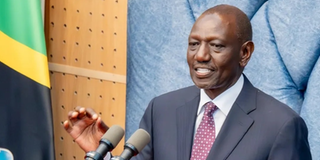
Kenyan President William Ruto addresses Parliament in Dodoma on May 5, 2026. PHOTO | COURTESY

Dar es Salaam. Kenyan President William Ruto has said the proposed oil refinery in Tanga, Tanzania, is part of a wider regional strategy to promote industrialisation, create jobs and add value to East Africa’s natural resources.

President Ruto, who arrived in Dar es Salaam on Monday, May 4, 2026 for a State visit, made the remarks during the Tanzania–Kenya Business Forum held the same day, where he defended his earlier announcement of the project, which had triggered diplomatic clarification between the two leaders.

He said the refinery idea emerged from regional consultations on how East Africa can jointly develop oil, mineral and agricultural resources rather than exporting them in raw form.

“Because the building of a refinery is a big opportunity for business, for industrialisation, for petrochemical industries, fertiliser and plastics industries,” Mr Ruto said.

“It is my belief, and that of the leaders in our region, that whatever raw materials we have, whether natural resources or energy, should be used for industrialisation so that we can create wealth here,” he added.

He further told the forum: “The good people of Tanzania, you are lucky that we are discussing constructing an oil refinery in Tanga.”

Diplomatic clarification

Mr Ruto’s explanation came after President Samia Suluhu Hassan said she had raised concerns over his earlier public announcement of the Tanga refinery without prior consultation.

She said she was not aware of the joint project when it was first mentioned two weeks earlier at an infrastructure forum in Nairobi.

“While we were speaking inside, I asked President Ruto, ‘You went ahead and announced a refinery in Tanga, which I was not aware of?’ He will explain himself why he made that announcement,” President Samia said during a joint engagement.

The earlier announcement was made at the Africa Infrastructure Summit in Nairobi, where Mr Ruto indicated that the refinery would serve Tanzania, Kenya, Uganda and South Sudan.

In response, Mr Ruto said the proposal was not unilateral, but part of broader regional discussions involving East African leaders on industrialisation and resource sharing.

He joked that had he known of the concern, he would have announced a refinery in Mombasa instead.

Push for regional integration

Despite the diplomatic exchange, both leaders used the forum to reaffirm commitment to deeper economic integration and industrial cooperation.

President Hassan called for closer relations between the two neighbours, stressing that challenges facing either country should be treated as shared concerns in the spirit of regional unity.

The two leaders also witnessed the signing of eight memoranda of understanding covering energy, legal cooperation, agriculture, railway development, public service capacity building, maritime affairs and standards harmonisation.

A key agreement between the Kenya Bureau of Standards and Tanzania Bureau of Standards will establish a joint framework to reduce duplication in certification and inspections at border points.

Another agreement focuses on reviving the Voi–Mwatate–Taveta railway line and linking it to the Standard Gauge Railway to improve freight movement to northern Tanzania, including Moshi and Arusha.

An energy cooperation deal will advance the Isinya–Singida transmission line and establish a joint working group on renewable energy projects.

Trade and non-tariff barriers

The two leaders set June 30, 2026 as the deadline for eliminating remaining non-tariff barriers, in line with a directive of the East African Community summit.

These barriers have long affected trade in products such as dairy, maize, eggs, steel and confectionery, with cross-border shipments often delayed by documentation and regulatory differences.

Bilateral trade between Kenya and Tanzania reached $860.3 million in 2025, accounting for nearly 40 per cent of intra-EAC trade, making the two countries the bloc’s largest trading partners.

President Ruto said the visit reflected the “deep-rooted and enduring friendship” between the two nations, while both leaders emphasised that the potential for trade growth remains significantly higher if barriers are removed and integration is strengthened.