Josephine Christopher is a senior business journalist for The Citizen and Mwananchi newspapers
Mwananchi Communications Limitted
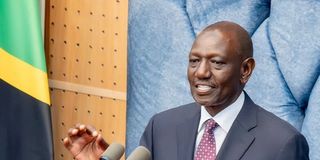
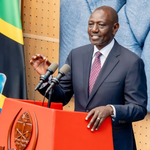
Dar es Salaam. Kenyan President William Ruto addressed Tanzania’s Parliament, saying Kenya and Tanzania are not merely neighbours, but deeply interdependent economies whose futures are inseparable.
Speaking in Dodoma on the second and final day of his two-day state visit, President Ruto framed the relationship as one built on shared history, geography and increasingly, economic necessity.
“I stand here, not because we are just neighbours, not just friends, nor even partners; we are brothers and sisters,” he told lawmakers, setting the tone for a speech that repeatedly returned to one central idea: shared destiny.
At the core of his argument was a blunt assessment—that while infrastructure and policy gaps remain, the biggest barrier to unlocking the full potential of the Kenya–Tanzania relationship is persistent mistrust.
“The time has come for our generation to move beyond incremental progress toward decisive integration,” President Ruto said.
“Our biggest barrier is not infrastructure or policy; it is the quiet mistrust that pervades our relations.”
President Ruto backed his argument with data that underscores how closely linked the two economies have become.
He noted that bilateral trade reached approximately $860 million in 2025 and is projected to hit $1 billion this year—figures he described as only a “fraction” of what is possible.
Kenyan enterprises have invested more than $1.7 billion in Tanzania across sectors including manufacturing, energy, logistics, financial services and agriculture, helping to create jobs and build local capacity.
At the same time, Tanzanian investments in Kenya—valued at over $336 million—are expanding steadily, with expectations they could more than double in the near term.
This two-way flow of capital, President Ruto argued, is reshaping the relationship from one of simple trade exchange to integrated production systems and shared value chains.
“These cross-border investments are not merely flows of capital; they are powerful catalysts for expanding trade,” he said.
Analysts say such dynamics are increasingly evident in agro-processing, where firms rely on raw materials, labour and markets across both countries, effectively blurring economic boundaries.
Proposed Tanga refinery touted as a regional asset
Within this broader framework, President Ruto addressed the proposed oil refinery in Tanga, an issue that has recently drawn public attention.
Rather than presenting it as a national project, he framed it as a regional asset grounded in shared ownership and benefit.
“While I would naturally have preferred such a facility in Mombasa, I fully recognise that Tanga… is part of the same economic space,” he said.
“What matters is not whether the asset is on one side of the border or the other, but whether it strengthens our shared prosperity.”
He added that Kenya is ready to invest as a strategic partner, signalling a shift toward joint ownership models for major infrastructure.
The Kenyan leader placed strong emphasis on geography as a natural driver of interdependence.
The nearly 800-kilometre border between the two countries, stretching from the Indian Ocean to Lake Victoria, is not just a dividing line but a corridor of trade, culture and human interaction, he said.
He pointed to cross-border communities such as the Maasai and Kuria, as well as the widespread use of Kiswahili, as evidence that integration is already a lived reality for citizens.
Even nature, he noted, reflects this interconnectedness, citing the annual migration of wildebeest between Serengeti and Maasai Mara.
“What nature has made seamless, policy must not make difficult,” he said.
President Ruto argued that interdependence must now be consolidated through deliberate investment in shared infrastructure.
He highlighted ongoing and planned projects, including the coastal road corridor linking Malindi, Lunga Lunga and Dar es Salaam, describing it as a strategic artery for trade and tourism.
Railway expansion plans from Voi through Singida toward Burundi, he added, could unlock hinterland markets and position East Africa as a gateway to the continent.
In the energy sector, he cited the Kenya–Tanzania power interconnector as a model of practical integration, noting that it has already synchronised electricity systems and enabled cross-border power trade.
Future projects, including additional transmission lines, are expected to deepen this integration further by combining Tanzania’s gas resources with Kenya’s geothermal and wind energy.
EAC and continental ambition
President Ruto extended the argument to the wider East African Community, noting that intra-regional trade remains between 15 and 20 percent of total trade—an indication of untapped potential.
Recent data shows total EAC trade rose to $156.6 billion in 2025, with intra-regional trade growing by 28 per cent, though still accounting for a relatively small share.
He urged member states to deepen integration as a pathway to fully benefit from the African Continental Free Trade Area (AfCFTA), which aims to create a single market of over one billion people.
Commends Samia for leadership, calls for deeper regional unity
President Ruto commended President Samia Suluhu Hassan for her leadership, saying she has played a key role in strengthening bilateral relations between Tanzania and Kenya and advancing regional cooperation in East Africa.
Dr Ruto expressed appreciation for the invitation to undertake what he described as an important State visit and thanked Tanzanians for the reception accorded to his delegation.
He said the visit reflected the close ties between the two countries, adding that relations go beyond diplomacy.
“I stand here not only because we are neighbours and partners, but because we are brothers and sisters,” he said.
Mr Ruto said his visit was also a gesture of reciprocity following President Hassan’s earlier engagements in Kenya and her continued leadership after the 2025 political transition.
He praised President Hassan’s role in fostering cooperation between the two countries, saying her leadership had contributed to strengthening bilateral engagement.
“I must commend the outstanding leadership of President Samia Suluhu Hassan on this meeting,” he said.
The Kenyan President said President Hassan had instructed officials from both countries to ensure that remaining barriers are resolved within the agreed timeline.
“That is why President Samia Suluhu Hassan and I yesterday instructed our officials that all non-tariff barriers must be addressed and cleared by the end of this month,” he said.
Register to begin your journey to our premium contentSubscribe for full access to premium content