Trade: Tanzania, Kenya set May deadline on barriers

President Samia Suluhu Hassan with Kenyan President Willian Ruto when he arrived at State House in Dar es Salaam April 04, 2026. PHOTO | STATE HOUSE 

Dar es Salaam. Tanzania and Kenya on Monday, May 4, 2026, agreed to eliminate all non-tariff barriers by the end of this month to improve trade between the two countries.

The two nations also agreed to establish a committee that will continuously monitor non-tariff barriers in order to identify new challenges and ensure that there are no obstacles to bilateral trade.
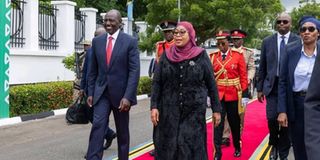
President Samia Suluhu Hassan said after closed-door talks with her Kenyan counterpart, Dr William Ruto, at State House, Dar es Salaam, that they discussed economic cooperation and pledged to improve various areas with the aim of strengthening economic relations between the two countries.

Also discussed were security issues, including drug trafficking and piracy, in order to strengthen safety in the region. President Ruto yesterday began his two-day state visit to Tanzania, which is aimed at strengthening bilateral relations between the two biggest economies within the East African Community (EAC).

Eight agreements were signed yesterday, including the integration of railway transport systems connecting Tanga, Taveta, and Kilimanjaro, and later linking the standard gauge railway (SGR) network to Singida and Kenya, agriculture, energy among others.

On aviation, President Hassan noted that cooperation is progressing well but there is a need to improve services further. In agriculture, she said Tanzania has sufficient food reserves and encouraged Kenyan traders to buy maize from Tanzania, but also proposed a structured government-to-government grain trade arrangement.

Tanzania also proposed cooperation in Information and Communication Technology (ICT) and innovation, particularly in empowering young people, with the aim of building a shared digital ecosystem between the two countries.

For his part, President Ruto said, “This visit reflects the deep-rooted and enduring friendship that binds our two nations, a relationship that is grounded on a common history, and is enriched by vibrant people-to-people connection, shared heritage, and a common destiny.”

He said Tanzania continues to be a valuable partner to Kenya. “Our relationship is grounded in a shared history, shaped by our founding fathers who championed Pan-Africanism and envisioned a continent that is politically united, economically integrated, and self-reliant.”

Guided by this vision, they laid the foundation for the EAC as a vehicle for regional integration, an idea that was born ahead of its time then.

President Ruto added that despite challenges along the way, their bilateral relations have remained resilient, vibrant, and wide-ranging, anchored in their shared commitment to sustainable development and shared prosperity.

“We noted the progress made under the Joint Commission for Cooperation, which has held four sessions since its establishment in 2009, and continues to serve as a vital framework for collaboration in trade, agriculture, education, and other key sectors. We look forward to the fifth session later this year. Her Excellency President Samia Suluhu Hassan has confirmed to me that I will have her support. It is important.’

Commenting on plans to invest in a refinery plant in Tanga, President Ruto said it is an investment that will increase industrialization in various areas including plastics, fertilizer among others.

He said many other countries within the EAC are willing to invest because it will create opportunities for all and build an ecosystem from Tanga to Mombasa, which is close and supports doing business together.

He added that they are also looking at Kenya’s role in processing minerals in the region, saying they must be deliberate and intentional not to export value. “We must add value right here. The longer we export raw materials, the more we export wealth and jobs. We have discussed Tanzania will lead the way. It will make no sense if we export raw materials and later import finished products.”

Earlier, investors said during the Tanzania-Kenya Investment Forum that the two countries should deepen economic integration, urging the two countries to move beyond traditional trade and build a unified commercial system capable of attracting large-scale investment.

Tanzanian businessman Rostam Aziz said the future of both economies lies in stronger private sector-driven integration.

Mr Aziz said discussions between the two nations should shift from trade to the creation of a single commercial system that can compete regionally and globally.

“We need to move from trade to something much bigger, a system that can compete and scale to attract capital for both regional and global markets.”

Mr Aziza added that such an approach would enable the two countries to achieve the scale needed to draw investment and accelerate economic transformation.

Mr Aziz also called for the harmonisation of Public-Private Partnership (PPP) frameworks to support transformative projects financed through capital market instruments such as bonds and initial public offerings (IPOs).

KCB Group CEO Paul Russo echoed similar sentiments, saying unlocking investment requires strong commitment and a shift from identifying opportunities to delivering results.

Mr Russo emphasised that the private sector thrives on predictability and transparency, noting that addressing mistrust remains key to unlocking investment flows.

“If we want to create scale, focusing on one country or one market will not work. We must be bold enough to open up,” he said.

He added that cross-border investments between Tanzania and Kenya have grown significantly in recent years, citing KCB Group as an example of how regional expansion strengthens business resilience.