University students empowered to report GBV through online course
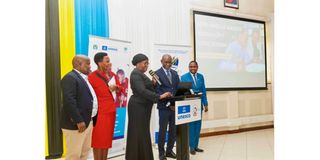
The Executive Secretary of NACTVET, Dr Mwajuma Lingwanda, and UNESCO Country Representative in Dar es Salaam, Mr Michel Toto (right), with key project actors from NACTVET during the launch of the CSE online course, witnessed live by participants. PHOTO | COURTESY
Dar es Salaam. University students are increasingly being equipped with knowledge and confidence to respond to gender-based violence (GBV) through the Our Rights, Our Lives, Our Future (O3 Plus) project, which is rolling out a comprehensive sexuality education online course across higher learning institutions.
The initiative aims to help young people understand their rights, recognise abuse, report GBV cases through appropriate channels, and access HIV testing and support services when needed.
Students aged between 15 and 24 in higher learning institutions often face a combination of academic, social and economic pressures, alongside limited guidance on sexual and reproductive health.
University of Dar es Salaam (UDSM) Medical Officer Dr Alfred Msasu said many students arrive on campus with limited knowledge of sexual and reproductive health and are exposed to peer pressure, financial constraints and unfamiliar social environments.
He said evidence shows that many young people lack comprehensive HIV knowledge, while risky behaviours such as unprotected first sexual encounters remain common. He added that universities have also reported cases of unintended pregnancies and GBV, highlighting the need for structured interventions.
Dr Msasu said it is in this context that the O3 Plus project was introduced in higher education institutions in Tanzania and other African countries, with its core being the online comprehensive sexuality education (CSE) course.
He said the course is designed to equip students with practical knowledge and life skills, covering adolescent development, sexual and reproductive health, relationships, gender equality, GBV prevention and financial literacy.
Delivered through institutional digital platforms, the course combines interactive modules, assessments and certification to encourage participation and completion.
He said the initiative has improved access to health information and services among students.
“Before the introduction of the O3 Plus interventions, many students lacked reliable information and did not know where to seek help. Now we are seeing more students coming forward for HIV testing and using campus health services,” he said.
He noted that the establishment of gender desks and clearer reporting mechanisms has also led to an increase in reported GBV cases, reflecting improved awareness and trust in reporting systems.
The National Council for Technical and Vocational Education and Training (NACTVET) Acting Director of Quality Assurance, Dr Mwajuma Lingwanda, said the rollout of the online platform marks a shift from planning to implementation.
“We now have institutions actively delivering the course and students completing it. The next step is to expand its reach and ensure it becomes a sustainable part of higher education in Tanzania,” she said.
She said universities have integrated sexuality education into orientation programmes, trained peer educators and established safer learning environments. Feedback mechanisms have also been introduced to allow students to assess services and suggest improvements.
However, challenges remain, including uneven participation in the course, limited internet access and the fact that the programme is not examinable. Some students enrol but do not complete the modules, highlighting the need for stronger institutional support.
UNESCO representative Mr Michel Toto said the O3 Plus initiative aims to empower students with knowledge, skills and confidence to make informed decisions.
“By working closely with universities, governments and students themselves, we are building systems that will continue to support young people beyond the classroom,” he said.