A verdict too neat: Reassessing the case against Samia today
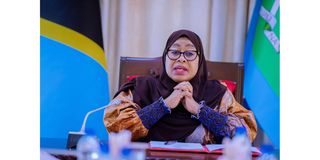
Preisdent of Republic of Tanzania, Samia Suluhu Hassan. PHOTO | FILE
By Protus Matipa
The accusation that President Hassan is Africa’s “most disappointing president” emerged on April 30, 2026, through a sharply worded editorial published by an international publication.
The article argued that the Tanzanian leader, initially viewed as a reformist when she assumed office in 2021, had instead presided over democratic decline, citing restrictions on the opposition, disputed elections and the forceful suppression of protests.
Such judgments carry weight in international discourse. Yet their force often comes from compression: years of political evolution condensed into a single sweeping conclusion. In doing so, they risk flattening a far more complicated reality.
A balanced assessment of President Hassan’s record must begin with the policy changes that followed the death of John Magufuli.
Her administration moved quickly to restore relations with multilateral institutions, rebuild investor confidence and reopen diplomatic channels that had become strained.
Tourism recovered, fiscal management regained credibility and Tanzania re-engaged more pragmatically with regional and global economic systems.
The government also reversed its approach to Covid-19. Unlike the previous administration, which largely downplayed the pandemic, President Hassan publicly acknowledged its seriousness, resumed data sharing and aligned Tanzania with international public health frameworks.
These decisions had measurable consequences for public health legitimacy and international cooperation.
They do not erase concerns about political freedoms, but they complicate attempts to portray her presidency solely as a story of decline.
A rigorous analysis must therefore hold two realities together: policy reform and political restriction. Ignoring either weakens the credibility of the argument.
The main criticisms concern democratic governance: the treatment of opposition leaders, media restrictions and questions surrounding electoral credibility.
These are not peripheral issues. They are internationally recognised benchmarks for assessing governance and democratic standards.
At the same time, the evidential basis for some claims remains contested. Assertions that largely peaceful protests escalated into widespread violence and deaths require careful scrutiny.
A disciplined assessment distinguishes between independently verified facts, official accounts and opposition narratives. Where evidence is incomplete, conclusions should reflect the degree of certainty available.
The same complexity applies to elections. Tanzania’s political history has long been shaped by the dominance of Chama Cha Mapinduzi, which has benefited from institutional continuity and structural advantages developed over decades.
Electoral outcomes cannot be understood solely through the lens of repression or manipulation.
Opposition parties themselves have often struggled with fragmentation, inconsistent leadership and weak nationwide mobilisation.
Ignoring these internal weaknesses risks attributing every electoral outcome entirely to state interference rather than recognising the interaction between institutional power and opposition capacity.
This does not diminish legitimate concerns over due process. Cases involving opposition figures such as Tundu Lissu inevitably raise questions about judicial independence and the rule of law.
Detentions or prosecutions of prominent critics, particularly where legal justification appears unclear, create perceptions of political motivation that are difficult to dismiss.
The broader question, however, is not simply whether Tanzania is democratic or authoritarian. It is whether the country is moving towards greater openness or greater restriction. The answer remains unsettled.
In dominant-party systems, periods of early liberalisation are sometimes followed by retrenchment as leaders confront competing pressures between reform and political control.
President Hassan’s administration reflects elements of both tendencies, making simplistic categorisation inadequate.
This is why the notion of a transitional presidency remains relevant, though imperfect. A transition implies movement towards clearer institutional reform and wider civic freedoms.
Several years into office, observers may reasonably expect a discernible trajectory. Yet Tanzania’s direction still invites competing interpretations rather than definitive conclusions.
Central to this debate is accountability. Investigations into politically sensitive incidents must be transparent, independently verifiable and publicly accessible. Without this, even substantial findings struggle to command public trust.
Legitimacy depends not only on outcomes, but also on the credibility of the processes used to reach them.
Media conditions present a similarly mixed picture. Outright bans may have diminished, yet subtler forms of pressure remain significant.
Regulatory constraints, legal risks and informal intimidation continue to shape the boundaries of public discourse. Measuring press freedom therefore requires attention not only to formal laws but also to how they are enforced in practice.
Economic performance offers clearer indicators. Tanzania has recorded substantial investment growth, major infrastructure expansion and continued development across several sectors under President Hassan’s leadership.
These achievements influence both domestic perceptions of stability and international evaluations of governance.
Yet economic progress and political legitimacy are not interchangeable. Development gains do not excuse restrictions on rights, just as political contestation does not negate policy achievements.
Serious analysis requires both dimensions to be assessed separately while recognising their interaction.
Ultimately, defining President Hassan entirely through the harsh verdict of a single editorial would ignore important countervailing evidence.
Equally, dismissing the concerns raised as mere alarmism would overlook serious unresolved questions about political freedoms and democratic accountability.
Her presidency is better understood as a mixture of policy recalibration and contested political practice.
The real question is not whether a publication can produce a striking headline, but whether that headline captures the full complexity of Tanzania’s evolving political trajectory. For now, the story remains unfinished.
Protus S. Matipa is a commentator on political and economic affairs