OBITUARY: The dream that eluded ‘Sir’ George Kahama in his time
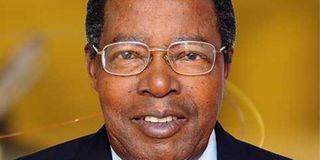
Former Home Affairs minister George Kahama
What you need to know:
When the idea of moving the government seat to Dodoma was first mooted, this was the man who was put in charge. He gave it his all to get the job done, but fate wouldn’t have it for him -- no, not in this life
In the early 1980s, George Kahama, the former cabinet minister who died on Sunday, was a busy man.
As director-general of the Capital Development Authority (CDA), a parastatal created to execute plans to relocate the government seat to Dodoma from Dar es Salaam, he was on his toes to ensure that the dream is fully realised.
Kahama, who was popularly known as Sir George, was a close associate of Mwalimu Nyerere from the pre-independence days, and no wonder, he was among the first members of the Tanganyika, later Tanzania, cabinet line-up. The only surviving minister in Tanganyika’s first cabinet is Mzee Job Lusinde.
In 1973, Mwalimu entrusted him with the task of capital transfer to Dodoma, knowing too well the abilities of the man who was in his first cabinet and who appeared more of a CEO than a politician despite, having held ministerial posts for years.
The capital transfer idea was still valid by the early 1980s despite the worsening economy impacted by the war against Idi Amin’s Uganda, the break-up of the East African Community in 1977, the global oil crisis and drought conditions.
At the helm of CDA, Kahama would not relent in his efforts to develop the town, which was then small by all standards. He would not settle down; instead he kept pushing his people to drive ahead implementation of whatever was in hand.
The capital transfer programme of those days was different from the current politically-driven, hurried move with ministries and its employees heading to the new seat, which is hardly prepared to accommodate thousands of new-comers.
Although Kahama was fully head-on in the capital transfer, knowing too well he had the backing of the all-powerful Mwalimu, he was not in a hurry. Instead, he focused his energies on putting up the requisite structures for the new capital.
The massive construction of the new capital, for instance, was to be undertaken largely using locally available building materials. A tiles factory was set up in Zuzu, west of the Dodoma, while a quarry to crush tonnes of the stones needed was established at the Nyankali rocky hills, along the Iringa road.
The Dodoma that the deceased former CDA boss aspired for was to have structures designed to be environmentally-friendly. These were to include avoiding high-rise structures, especially outside the central business district (CBD), where there was a limitation for the number of storeys.
Dodoma, which is located at the centre of the country’s dry zone, was also envisaged to have enough green zones. That would minimise or check the amount of dust blown during the dry seasons and beautify what was intended to be the new seat of the government.
A full directorate was created to undertake the green programmes under the stewardship of an accomplished forester Thomas Mtei.
By 1983, when CDA marked 10 years since the capital transfer idea was launched, the afforestration, reforestration and land reclamation or whatever you would call it, was one of the most successful projects undertaken for the new capital.
The idea of capital transfer did not face much opposition those days as is the case today. It was still a material for the foreign donors who pledged full support. In fact, Dodoma of those days was a hive of activity with visitors coming in from all sides.
Those from African countries, such as Nigeria, came in droves to learn the Tanzanian experience in capital transfer as they were preparing to move to Abuja from the congested Lagos. The donor representatives wanted to know where they can chip in with their assistance. Kahama was at hand to receive and brief them.
However, may be due to economic problems the country faced at that time, the Dodoma capital slowly turned into a pipe dream until President John Magufuli’s resolve last year to hasten the pace.
Towards the mid-1980s, the idea could no longer sound well with the new wave of donors who rushed in to rescue the economy as Tanzania prepared to embrace the tough conditions of the Bretton Woods institutions (World Bank and IMF) in order to get the badly needed finances.
That was around 1984. Mwalimu Nyerere finally bowed down to pressure to liberalise the economy, and was soon to exit from the presidency. In the major changes that followed, Kahama found himself appointed an ambassador to China, leaving the Dodoma programmes to move at a snail’s pace.
The fallen former politician, though, had an illustrious carrier in the government. He landed on one of the powerful cabinet dockets, Home Affairs, as minister, immediately after independence in 1961.
The docket was later to land on other key personalities in the country’s history, including Mzee Ali Hassan Mwinyi, the second phase Union president, Salmin Amour, who later became Zanzibar president, Oscar Kambona, the powerful Tanu secretary-general who rebelled against Nyerere for the latter’s socialist policies and Augustine Lyatonga Mrema, a key opposition figure.
Kahama did not last long in the cabinet position after independence. In or around 1964, Nyerere appointed him to the key position of general manager of the National Development Corporation (NDC), a parastatal created to pave way for industrialisation.
He held the position for nearly a decade. His tenure saw many industries and other key parastatals such as the Tanzania Tourist Corporation (TTC) established. In fact, NDC was more or less an apex body for the parastatal sector and remains much stronger today.
It was at NDC, probably the oldest parastatal organisation after the National Housing Corporation (NHC) and the Tanzania National Parks (Tanapa), that exhibited Kahama’s administrative and management skills.
At one time during the administration of President Mwinyi, Kahama was the country’s High Commissioner to Zimbabwe, a key ally of Tanzania during the height of the anti-apartheid struggle.
Upon the end of his tour of duty in diplomatic posts in Beijing and Harare, he was appointed the director-general of the Investment Promotion Centre (IPC), later to become Tanzania Investment Centre (TIC), a key institution for the liberalised economy.
During the second phase of the administration President Benjamin Mkapa, he was made the minister in charge of cooperatives.
However, the docket lasted for only a few years and that saw the marginalised the sector, which played a role in his earlier education, support to the farmers and contribution to the struggle for independence, almost on a nose dive.