On March 10, 2026, a mining agreement was signed at the United States Department of State in Washington, D.C. The subject was Burundi’s Musongati nickel laterite deposit — over 150 million metric tonnes grading 1.31 percent nickel, one of the largest undeveloped deposits of its kind on the continent.
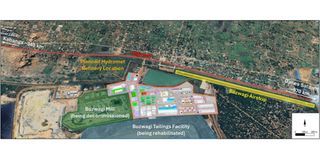
However, read the structure and the deal is, fundamentally, about Tanzania. The Standard Gauge Railway is the corridor. The Kahama Hydromet Refinery in Buzwagi Special Economic Zone is the processing hub. The port of Dar es Salaam is the exit point. Burundi’s nickel cannot reach global markets without Tanzania’s infrastructure.
That is not geography. That is leverage — earned through years of capital-intensive decisions that many, at the time, called premature. They were not premature. They were strategic and the world has now noticed.
The numbers need no embellishment. Phase II of the Tanzania–Burundi–DRC SGR is under construction under a $2.154 billion contract, anchored by $ 696 million in African Development Bank financing. Tanzania’s GDP is projected at 6.1 percent in 2026. Gold is above $5,000 per ounce. UAE FDI reached $502 million in Q3 2025 alone. Intra-EAC trade grew 27 percent to $ 18 billion between mid-2024 and mid-2025, much of it moving through Tanzanian corridors.
These figures are the commercial logic that placed Tanzanian infrastructure at the centre of a deal signed four thousand miles away. The government has earned this moment and should hear that said plainly. What it cannot do is treat arrival as destination.
Consider what the Lifezone deal actually requires to function. Ore must travel from Musongati through Ngara along the SGR to Kahama, be refined, and reach Dar es Salaam for export — a multi-jurisdiction, multi-modal supply chain spanning two sovereign legal regimes. Structured trade finance instruments: corridor-specific letters of credit, supply chain guarantees, working capital facilities calibrated to mineral flows of this scale, are not designed into environments where the regulatory ground is unstable.
Yet Tanzania’s banking data signals the economy is ready. Payment values are growing far faster than volumes — institutional and cross-border settlements expanding as the economy matures. Government digital collections rose 20 percent year-on-year to Sh333 billion in 2025. The financial system is maturing faster than the instruments within it.
That gap is not a banking problem. It is a legal predictability problem wearing a finance hat. Which brings me to Kahama on March 13 — three days after Washington. The Parliamentary Standing Committee on Governance, Constitutional and Legal Affairs visited the Buzwagi SEZ and produced two findings that deserve more attention than they have received.
First, it recommended transferring zone management from Kahama Municipal Council to Tanzania Investment and Special Economic Zones Authority (Tiseza). Straightforwardly correct: 35 investors are interested, six factories are operational, and no serious investor structures a long-term commitment around a municipal council’s licensing discretion. Second, the committee identified contradictions between laws that risk deterring investment and referred the matter to Parliament.
The statutes were not named publicly. In my experience advising investors navigating Tanzania’s regulatory framework, they never need to be. The fault lines are known: the tension between the Tanzania’s Investment Act and sector-specific legislation; local content obligations distributed without coherent hierarchy across the Mining Act, EWURA regulations, and ministerial instruments; and the 2017 Natural Wealth and Resources Acts — passed under a certificate of urgency, with definitions so broad that “natural wealth” has never been resolved to the precision that bankable project finance requires.
Tanzania is being selected. The Lifezone deal, the SGR corridor, the EAC Customs Bond launched at the March 7 EAC Summit — these are converging signals of a structural shift in how global capital reads this country. However, selection is not a trophy. It is an audit. Every investor who arrives because of the infrastructure will leave because of the law — if the law gives them reason to.
Policymakers must treat the committee’s findings as a legislative emergency.
Amne Suedi is Managing Director of Shikana Investment and Advisory, Honorary Consul of Switzerland to Tanzania, and Chair of the Switzerland-Tanzania Chamber of Commerce. You can contact her at [email protected]