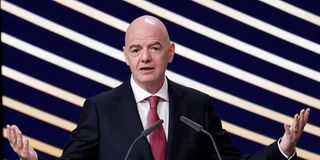
Zurich. FIFA president Gianni Infantino’s future at the helm of world football’s governing body has been thrown into uncertainty after his ambitious plan to bring private investors into the organisation’s commercial operations collapsed following strong opposition from football leaders.
FIFA on Friday confirmed that a proposal to create a new commercial entity to manage the World Cup and other tournaments, with 20 per cent ownership offered to private investors, would not proceed after triggering widespread criticism.
The decision ended three days of turmoil in global football, which intensified when UEFA, the wealthiest and most influential of FIFA’s six continental confederations, threatened to boycott all FIFA events unless the plan was abandoned.
The setback came less than two weeks after FIFA concluded its most financially successful World Cup, leaving Mr Infantino facing the biggest challenge of his presidency as he prepares for a possible fourth term.
A week earlier, his re-election at the FIFA Congress in Morocco in March appeared almost certain, with no major challengers emerging. However, analysts now say the political landscape has changed dramatically.
“Last week, Infantino was riding high and was almost certain to get elected overwhelmingly because he had overseen such a financially successful tournament. That is all in jeopardy now,” Victor Matheson, a professor of economics at the College of the Holy Cross in Massachusetts, told Reuters.
Leadership style under scrutiny
Mr Infantino, who became FIFA president in 2016 following the corruption scandal that ended Sepp Blatter’s 17-year leadership, has often faced criticism over his independent approach to decision-making.
However, his ability to increase FIFA’s revenues and maintain financial support for national football associations has previously helped him overcome controversies.
He abandoned a proposal in 2018 for a $25 billion private investment package for the Club World Cup after opposition from UEFA.
He also survived criticism over his defence of Qatar as the 2022 World Cup host and a controversial pre-tournament speech in which he compared himself with marginalised groups, including migrants and people with disabilities.
This latest proposal, however, created a deeper crisis because FIFA’s key stakeholders said they were not consulted before the announcement.
The plan was revealed after details were leaked to newspapers, while many football leaders said they only learned about it after Mr Infantino had already met potential investors.
The proposed investment group was expected to be led by Thrive Capital, founded by Joshua Kushner, whose family links to US President Donald Trump attracted additional scrutiny.
FIFA senior adviser Carlos Cordeiro resigned, describing the proposal as “a bad deal for football”, while FIFA Chief Operating Officer Kevin Lamour accused the leadership of misleading staff and called it a “project of one person”.
The Asian Football Confederation also criticised the process, describing it as an unacceptable departure from established procedures and calling for institutional reforms at FIFA.
Trump relationship adds pressure
Mr Infantino’s close relationship with President Trump had already attracted attention after FIFA awarded the US leader its first Peace Prize in December.
Former FIFA vice-president Jim Boyce suggested that Mr Infantino’s growing proximity to political influence may have affected his judgement.
“I think what has happened here is that fame appears to have gone a little bit to Gianni’s head and his relationship with Donald Trump during that World Cup is nothing more than astounding,” Mr Boyce told the BBC.
During the World Cup, Mr Trump said he had contacted Mr Infantino over the suspension of US player Folarin Balogun following a red card, asking whether the punishment could be overturned.
Although FIFA’s independent disciplinary body ultimately allowed the player to feature after reviewing the case, the incident fuelled perceptions that political influence was entering football decisions.
Sports marketing analyst Bob Dorfman said the involvement of a Trump-linked investor further increased concerns surrounding the private equity proposal.
“It didn’t help that you had a Kushner involved in this whole thing,” he told Reuters.
Mr Trump said on Friday that he had not discussed the proposed sale of stakes in the World Cup with Mr Infantino.
Fight for survival
Despite the setback, analysts say it is too early to rule out Mr Infantino’s chances of remaining FIFA president if he decides to seek another term.
The private equity plan was aimed largely at FIFA’s 211 member associations, many of which depend on funding from the organisation and have benefited financially during Mr Infantino’s tenure.
To secure another term until 2031, Mr Infantino would need a two-thirds majority in the first voting round or a simple majority in later rounds.
Mr Dorfman said an admission of mistakes could help rebuild support among football leaders.
“I know that is not in his manner to do things like that, but maybe he has to start apologising a little bit and say: ‘Maybe I handled this wrong,’” he said.