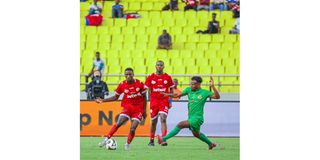
It has emerged that ahead of the highly anticipated Kariakoo derby between Young Africans (Yanga) and Simba in the Tanzania Mainland Premier League, scheduled for March 1 at the New Amaan Complex, the Tanzania Football Federation (TFF) is in the process of identifying a betting firm to partner with for the match under a special trial agreement
Dar es Salaam. A growing number of football stakeholders believe the time has come for the Tanzania Football Federation to formally partner with a betting company.
The renewed debate follows reports that TFF has signed a three-year Memorandum of Understanding (MoU) with a private limited liability company mandated to oversee the auction of exclusive betting rights linked to Tanzanian football competitions.
Under the arrangement, the appointed firm will also work with a licensed stockbroker to conduct a comprehensive valuation of the Tanzania Mainland Premier League and other domestic competitions.
According to information obtained by The Citizen, the valuation exercise is designed to establish the true commercial value of Tanzanian football assets and open the door to credible investors, capital market participation and more sustainable commercial growth.
Observers say the initiative signals a major shift in football governance, with TFF seeking to align the local game with modern commercial practices seen in established football economies.
It has emerged that ahead of the highly anticipated Kariakoo derby between Young Africans (Yanga) and Simba in the Tanzania Mainland Premier League, scheduled for March 1 at the New Amaan Complex, the Tanzania Football Federation (TFF) is in the process of identifying a betting firm to partner with for the match under a special trial agreement.
The pilot arrangement is intended to assess key metrics, including the number of participants placing bets and the level of revenue generated.
The findings will be carefully evaluated before the federation formally announces an open auction in line with established procedures and regulations.
Stakeholders welcome new revenue prospects
Former TFF secretary general Mwesigwa Celestine is among those who believe the timing is right for the federation to formalise betting partnerships.
He notes that Tanzanian football already features prominently on betting platforms, yet the federation has historically received no direct financial benefit.
“Football in Tanzania continues to generate value for betting companies, but the federation earns nothing from it,” said Mwesigwa. “This should not continue.
A structured partnership will enable TFF to generate revenue and reinvest it in developing the game.”
He argued that income from betting deals could be channelled into grassroots football, refereeing, league organisation and infrastructure development.
“At the same time, a formal agreement would help TFF put systems in place to curb match-fixing and promote responsible betting,” he added.
Mwesigwa pointed out that Tanzania currently has numerous betting companies operating platforms that include domestic league matches, yet none has been officially granted rights by the federation.
“Fans continue to bet using different companies, and those firms make money while TFF gets nothing. It is time to act so that the federation increases its income,” he said.
Football needs fresh investment
The argument that betting partnerships could inject much-needed resources into the game is shared by academy owners and private investors involved in youth development.
Peter Simon, one of the owners of a football academy, said Tanzanian football has grown significantly in recent years but still requires substantial investment to compete at regional and continental levels.
“Tanzanian football has expanded and now needs serious financial input,” said Simon.
“TFF must use the opportunities that exist to generate revenue through sponsors and betting companies.”
He stressed that any partnership should be properly regulated and aligned with the long-term interests of the sport, but insisted that ignoring available commercial opportunities would only slow progress.
“Any sponsorship arrangement that has value is meant to increase income,” he said. “TFF should take advantage of what is available now to strengthen its financial position.”
TFF has not acted late
Former TFF secretary General Mwina Kaduguda has also dismissed claims that the federation may have missed its chance to capitalise on betting partnerships.
According to him, the market remains strong and full of opportunity.
Kaduguda, who previously served as a senior leader at Simba SC, said betting has become an integral part of modern football economics worldwide.
“TFF has not acted late in seeking a betting partner or other sponsors to help increase revenue and raise the value of the league and other competitions,” said Kaduguda.
He added that betting now plays a major role in football financing globally, from club sponsorships to competition partnerships.
“In England, many clubs are sponsored by betting firms. Even the Confederation of African Football is sponsored by betting companies alongside other partners. They generate revenue from it, so why not TFF?” he asked.
Betting, regulation and integrity
While betting partnerships often raise concerns about integrity, several stakeholders argue that formal agreements can actually help fight match manipulation rather than encourage it.
By entering into an official partnership, TFF would be better placed to monitor betting patterns, share data with integrity units and cooperate with law enforcement and international bodies to detect suspicious activity.
Operating outside a formal framework, Mwesigwa warned, leaves the federation powerless.
“Betting happens anyway, but without oversight,” he said. “With a proper agreement, TFF can set rules, monitor activities and educate players and officials. That is far better than the current situation.”
Boosting league value and competitiveness
Analysts believe that a well-managed betting partnership could significantly raise the commercial value of the Tanzania Mainland Premier League and other competitions.
Additional revenue could improve match organisation, officiating standards, youth leagues and women’s football, while easing the financial burden on clubs that often struggle with operational costs.
“When the league is strong financially, everything else improves, clubs, players, referees and even national teams,” said Kaduguda.
He said that stronger finances could eventually translate into better performances on the continental stage.