East African nations unite against illegal fishing in Zanzibar summit
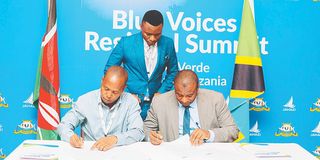
The Director General of the Kenya Marine & Fisheries Research Institute (KMFRI), Dr Paul Sagwe Orina, (left), and Officer in Charge of the Ministry of Blue Economy and Fisheries, Zanzibar, Dr Salim Mohamed Hamza, sign the cooperation pact during the Blue Voices Summit in Zanzibar. Witnessing behind them is The Jahazi Project’s Spokesperson Michael Mallya. PHOTO | COURTESY
Zanzibar. Regional leaders and fisheries experts have sounded the alarm on illegal fishing in the South West Indian Ocean, warning that foreign industrial fleets are "plundering" local waters.
At a high-level summit in Zanzibar, officials from across East Africa vowed to crack down on unregulated fishing (IUUF), noting that enforcement gaps are currently allowing outsiders to drain coastal economies.
The three-day Blue Voices Regional Summit, hosted in Zanzibar under the Jahazi Project, brought together ministers, legal officers, and maritime agencies from Tanzania and Kenya to coordinate regional action. Delegates framed IUUF as a challenge not only to marine ecosystems but also to sovereignty, livelihoods, and economic development.
“Illegal fishing is not just an environmental issue; it is about food security, livelihoods, sovereignty, and development,” said Mboja Ramadhani Mshenga, Deputy Minister in Zanzibar’s Ministry of Blue Economy and Fisheries.
During plenary and closed sessions, delegates raised concerns over distant-water commercial fleets, particularly vessels linked to Southern and Eastern Asian interests, including some associated with Chinese companies.
Speakers stressed the focus was on compliance and enforcement, not nationality, but noted that industrial-scale operations and opaque ownership structures make monitoring and accountability difficult.
Foreign fleets, participants argued, operate beyond the capacity of local monitoring, while fragmented legal frameworks across coastal states allow operators to shift activities between jurisdictions. “We must ensure that those who exploit our waters find no haven anywhere in our region,” said Hon. Mshenga.
Officials described IUUF as “economic theft” from coastal communities, where fisheries provide vital income and food security.
Dr Paul Orina, Director General of the Kenya Marine and Fisheries Research Institute, stressed the importance of regional collaboration.
“Illegal actors succeed when countries act alone and fail when regions act together,” he said.
Legal experts highlighted that inconsistent penalties across countries encourage offenders to relocate activity to less restrictive jurisdictions. Leonard Bett Cheruiyoti, Deputy Chief State Counsel in Kenya, warned: “When penalties are low in one jurisdiction, crime migrates there.”
The summit concluded with commitments to strengthen legal coordination, harmonise prosecution frameworks, and improve information sharing among maritime and fisheries authorities.
Captain Hamad Bakari Hamad, Principal Secretary in Zanzibar’s Ministry of Blue Economy and Fisheries, said:
“Securing our seas together is not a slogan; it is an economic necessity.”
Several participating countries signed a regional cooperation framework, signalling a move from fragmented national responses towards coordinated governance of the South West Indian Ocean.