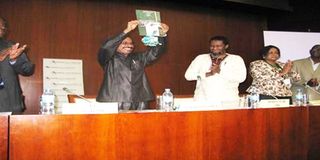
The minister for Health and Social Welfare, Dr Seif Rashid, launches Service Availability and Readiness Assessment Report in Dar es Salaam on January 2014. PHOTO | David Mbulumi
What you need to know:
The report of the study contains valuable findings, which are the benchmark for evidence based decision-making. The report was launched by the minister for Health and Social Welfare, Dr Seif Rashid, in Dar es Salaam on 28 January 2014.
Dar es Salaam. The Ifakara Health Institute (IHI) on behalf of the ministry of Health and Social Welfare (MoHSW) has completed a study on Service Availability and Readiness Assessment (Sara) for the health facilities in Tanzania Mainland.
The report of the study contains valuable findings, which are the benchmark for evidence based decision-making. The report was launched by the minister for Health and Social Welfare, Dr Seif Rashid, in Dar es Salaam on 28 January 2014.
The report of a study conducted in 2012 provides for a snapshot of the status of health service provision in Tanzania Mainland. The study used an international standard questionnaire instrument and indicators.
Data was collected from a sample of districts and health facilities to provide a representative portrayal of health services in the country as a whole. The survey provides estimates of general health care availability and readiness, as well as detailed assessment of specific areas of health provision.
General availability of health services was assessed by comparing the total number of health facilities on the master list with the total population (projected) in the sample districts. Overall, there were 1.5 health facilities per 10,000 people, ranging from a minimum of 0.6 in Geita to a maximum of 6.0 in Sumbawanga.
Across the 1,297 health facilities sampled, there were 8,838 professional health workers, equivalent to 7.1 of the core health personnel per 10,000 people.
Sixty seven per cent of all personnel worked in government health facilities, 14 per cent in mission/faith-based facilities and 18 per cent in private-for-profit facilities. Overall, 69 per cent of the workforce was stationed in urban areas and 31 per cent in rural areas.
Medical doctors made up 6 per cent of the workforce sampled, non-physician clinicians accounted for 32 per cent, nurses 48 per cent and midwifery professionals made up the remaining 14 per cent.
The report is very comprehensive and gives a very good picture of the situation of the health service provision in the country from equipment, diagnostic ability, standard precautions for infection prevention, availability and readiness to provide services such as family planning, antenatal care, malaria services and so on. However, this article focuses only on two issues: infection prevention and diagnostic capacity.
Infection prevention is an essential aspect of basic health care as well as specialised services. Ordinarily, all health facilities should possess all of the items - sterilisation equipment (autoclave or dry heat steriliser and heat source such as gas or wood if the machine is not electric).
They should have safe final disposal of sharps and infectious wastes like disposal by incineration, open burning in a protected area or dumping without burning in a protected area. They should have appropriate storage of sharp wastes (in sharp boxes).
All health facilities are expected to have disinfectant, disposable or auto-disable syringes, soap and water or alcohol based hand rub, latex gloves, medical masks, gowns, eye protection and guidelines for standard precautions. In practice, the assessment shows that the average scores for infection prevention (mean percentage of all facilities that satisfied each of the criteria) is only 45.
Among the individual elements, the lowest score (11 per cent) was found for “safe final disposal of infectious waste”. Similarly, although appropriate storage for sharp wastes was available in two thirds of the facilities, a safe final disposal of sharps was available in less than half of health centres and less than a third of dispensaries. The availability of sterilisation equipment was also surprisingly low.
More than one in five of the 1,100 dispensaries were reported not to have disinfectants, over two thirds lacked medical masks and gowns while four fifths did not have eye protection. Scores of health centres were generally superior to dispensaries but even here the overall score was only 52 (compared to 43 for dispensaries and 68 for hospitals).
Even the most basic infection prevention of all (soap and water) was available at only 50 per cent of dispensaries, 47 per cent of health centres and 56 per cent of hospitals. The very low frequency of facilities possessing each of these basic elements for infection prevention should be a cause for serious concern.
The study also examines the availability of a selection of basic diagnostic tests. Capacity to conduct all of these tests would normally be expected at general hospitals and most health centres, while diagnostic capabilities at dispensaries normally are limited to rapid tests.
Recalling that almost 85 per cent of the facilities in the sample were dispensaries, it is not surprising to find that diagnostic capabilities, for the sample, as a whole were very low, with a mean availability score for all items of 25 per cent. Malaria testing capacity was present in only 41 per cent of all facilities in the sample.
More surprising was the relatively low score for diagnostics in hospitals. Overall, the hospital diagnostics mean score was 45. Private facilities generally had higher scores for diagnostics availability than government facilities and urban facilities had more diagnostic capabilities than rural ones.
It is true that the government fails in some of these areas because of budgetary limitations. But at least it should be able to provide soap and water for health facilities. It may seem ironic that the place where people go to be healed can make them sick.
The World Health Organisation (WHO) country representative, Dr Rufaro Chatora, who also attended the report launch said: “Of more relevance is where do we want to be? We need to do a thorough reflection:
To improve…will it come as a matter of normal routine or should improvement come through putting interventions from the results of this study? We need to do the latter. Once we identify a problem we must fix it immediately. We should not see a problem and just admire it,” he said.
The author is a development communications specialist.