Samia endorses revenue drive as she receives 284 proposed tax reforms
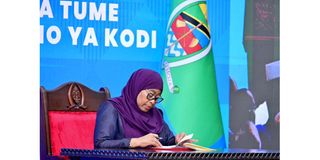
President Samia Suluhu Hassan take notes as she receives the Presidential Commission’s report on tax reforms at State House, Dar es Salaam, 18 March 2026.
Josephine Christopher is a senior business journalist for The Citizen and Mwananchi newspapers
Mwananchi Communications Limitted
Dar es Salaam. President Samia Suluhu Hassan has placed domestic revenue mobilisation at the centre of Tanzania’s economic strategy, endorsing sweeping tax reforms proposed by a presidential commission as the country faces declining foreign aid and tightening global financing conditions.
Speaking after receiving the report of the presidential commission on tax reforms on 18 March 2026, the President said Tanzania must increasingly rely on its own resources to finance development, warning that geopolitical tensions and changing global dynamics are constraining access to external capital.
“In the emerging global economic order, countries that will succeed are those with stable and predictable economic and trade policies, supported by strong institutions,” President Hassan said. She added that domestic resource mobilisation must now become a key pillar of national development.
The commission, chaired by former Chief Secretary Ambassador Ombeni Sefue, tabled 284 recommendations aimed at overhauling the tax system to make it more predictable, inclusive and growth-friendly.
President Hassan noted that Tanzania’s development needs remain substantial and cannot be met without strengthening revenue collection.
“Our needs are large, and the resources mobilised so far are not enough. That is why we must collect more so we can finance our own priorities,” she said, pointing to the decline in donor support.
“External assistance is reducing. We must now focus on strengthening our internal capacity to generate revenue,” she added.
While commending the Tanzania Revenue Authority (TRA) for improving collections, the President said much economic activity remains outside the formal system, limiting the country’s revenue potential.
“A significant number of citizens still operate in the informal sector. Formalisation of businesses will be a key priority to ensure fairness and expand the tax base,” she said.
She said improved domestic revenue would not only enable the government to implement its development agenda but also strengthen partnerships with the private sector in delivering major projects.
President Hassan welcomed the commission’s report and signalled readiness to act on its proposals, saying the government will adopt a phased implementation covering short-, medium- and long-term measures.
“Some recommendations will be implemented immediately, especially those that do not require extensive preparation. Others will follow in phases—but long term does not mean waiting until 2050,” she said.
She added that she is keen to leave behind a strong and complete system as a foundation for the country’s Vision 2050. “I would like to see these reforms implemented and a solid foundation established for where we are going,” she said, noting that the process will involve the private sector, citizens and civil society organisations.
Ambassador Sefue said the commission’s proposals are designed to address structural weaknesses in the tax system that have undermined efficiency, fairness and investor confidence.
The review was conducted during a period of steady economic growth of over six percent, benchmarking Tanzania’s system against countries including the United Kingdom, India, Vietnam and South Korea.
Despite the growth, the current framework is characterised by frequent policy changes, high tax rates in some areas, and multiple levies introduced without coordination, creating uncertainty for businesses and investors.
“The tax system must not produce negative outcomes on business and investment. It should support inclusive growth and poverty reduction,” Ambassador Sefue said.
He highlighted a narrow tax base, where a small number of formal sector taxpayers bear a disproportionate burden while many operating informally remain outside the system. Revenue collection remains below 16 percent of GDP, below the regional average and national targets.
The commission also found that the tax dispute resolution system lacks independence, leading to low taxpayer confidence, and noted overlapping mandates among revenue authorities, high costs and compliance burdens for small businesses.
To address these issues, the commission grouped its recommendations into seven areas. The largest, 146 proposals, focus on tax policy and legislation, including a National Tax Policy and principal Taxation Act to provide a clear and consistent legal framework. Other proposals include updating outdated laws and ensuring new taxes align with national objectives.
On technology, the commission proposed 41 measures to modernise tax administration, including a mobile application for registration, filing, payments and access to services, aiming for a faceless and paperless system to improve transparency and efficiency.
Administrative reforms include 30 changes, such as renaming the Tanzania Revenue Authority to Tanzania Revenue Service and shifting performance metrics to emphasise accuracy and service delivery alongside revenue collection.
Other recommendations include a one-year tax grace period for startups, strengthened dispute resolution, better taxpayer education, wider adoption of electronic fiscal devices and improved ICT integration.
“With the report now in government hands, the focus is on translating the recommendations into reforms that could reshape Tanzania’s tax landscape,” Ambassador Sefue said.
Register to begin your journey to our premium contentSubscribe for full access to premium content