Dr Temba first moved abroad in the 1960s under a government scholarship that took him to Mexico. His strong academic performance soon opened doors in the United States, where he eventually built a long career in industrial engineering and later earned a PhD in Applied Management, Decision Science and Information Management Systems from Walden University.
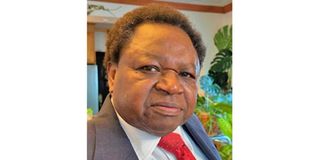
As we spoke, his grandchildren occasionally wandered in to ask for the computer. Dr Anicetus Temba chuckled, noting that for young people in the United States, access to information is not a luxury but a necessity. The New York–based scientist, who left Tanzania more than four decades ago, has watched recent political developments back home with keen interest.
Dr Temba first moved abroad in the 1960s under a government scholarship that took him to Mexico. His strong academic performance soon opened doors in the United States, where he eventually built a long career in industrial engineering and later earned a PhD in Applied Management, Decision Science and Information Management Systems from Walden University.

As reactions from development partners—including the European Union, the Thabo Mbeki Foundation, Ghana and the United States—flowed in following President Samia Suluhu Hassan’s December 2 address to Dar es Salaam elders, Dr Temba observed that the tone and messaging in the statements were strikingly similar.
“There are many levels of intergovernmental communication they could have used before going public,” he said.
He argues that geopolitics and geoeconomics now shape the pressures facing developing nations, cautioning that small decisions can trigger disproportionately large consequences—what he calls “quantum tension” in global politics.
“All these nations want to survive. Neither Europe nor America can survive without Africa. Their presence is vital for their interests, not ours,” he said.
Asked whether Western governments were genuinely driven by concerns about political violence and human rights, he responded bluntly: “To be honest with you, they are not.” He pointed to historical examples of African resources fuelling Western power, including uranium mined in Shinkolobwe in today’s Democratic Republic of the Congo and used in the atomic bomb dropped on Hiroshima.
“From minerals that took them to space to those that built their industrial base, Africa has always been the denominator. Now we have rare-earth minerals still untouched, and that explains the keen interest in our politics,” he said.
His comments echo sentiments expressed by senior Tanzanian officials regarding what they see as unusual foreign involvement in the country’s internal affairs.
Global institutions and local pressures Dr Temba revisited the origins of the World Bank and the International Monetary Fund (IMF), established at Bretton Woods in 1944 to support post-war reconstruction and global economic stability. He noted that scholars from Africa and Asia have long argued that loan conditions and institutional structures have often created political and economic pressure rather than empowerment.
“These institutions do not help countries like Tanzania out of pity; it is their obligation. But loans and aid are often used as tools of leverage,” he said.
He pointed to a recent statement by the US embassy suggesting that the October 29 unrest could affect future US investment in Tanzania—a message he reads as part of a familiar playbook across the continent.
European countries stressed the need to uphold fundamental freedoms, including access to information. Dr Temba agrees wholeheartedly that Tanzania must invest in its knowledge economy.
“Tanzania has highly educated people. Access to information is crucial for their development. Restricting platforms like Clubhouse or X limits their ability to engage with global intellectual communities. The government should support academia, not fear it,” he said.
He noted that many Tanzanians in the diaspora would gladly invest at home but face institutional limitations: “We are doing many things here in the US, but we cannot take them home because the country is not ready. Can Tanzania give us that chance?”
A question of sovereignty and equal partnership for Dr Temba, sovereignty lies at the heart of the current tensions. If Tanzania and its partners truly share the values of democracy, he said, there must be mutual respect. “We are viewed as inferior, yet we support their survival. There should be reciprocal respect, not finger-pointing. Leaders can always sit down and talk,” he said.
Tanzania’s long history in the Pan-African struggle, he added, means the country plays an outsized role in regional politics. This, he believes, explains why recent statements from development partners carried unusually strong language, signalling pressure rather than partnership.
“Tanzania’s main objective has always been to remain independent. Our position between East and West reflects that,” he said.
Diplomatic tensions will fade, he predicts. Despite the strong public statements, Dr Temba does not foresee escalation into harsh penalties such as tariffs or travel bans—tools sometimes used against other African nations.
He believes the tensions will subside within weeks or months. “For over 60 years, we have never had this level of misunderstanding with global partners. This is an outlier. Once corrected, it will not happen again,” he said.
His advice to the government is straightforward: listen to citizens.
“The people are the owners of the country. They are not the ruled; they are the rulers. The government is their employee. If leaders listen to the people, they will succeed; if not, they will fail,” he said.
Despite the ongoing situation, he said the Tanzanian diaspora remains calm and optimistic.
A new age of youth and information Dr Temba views the current youth mobilisation not as a crisis but as part of a global trend.
“Gen Z everywhere is in transition. Demonstrations by young people are happening across the world. It is a new age of leadership and information, and Tanzania is no exception,” he said.
Today’s youth, he noted, can communicate instantly with peers across continents. Information spreads faster, and political awareness is sharper than in previous generations.
“The young intellectuals in Tanzania are many. They will always find ways to express their views,” he said.
How the diaspora is defending Tanzania’s image Dr Temba credits the diaspora for helping stabilise Tanzania’s international reputation during the recent turbulence.
“If it weren’t for us, the situation would have been worse,” he said. Diaspora members have been fielding questions from investors, colleagues and neighbours eager to understand events back home. “We engage people and provide them with answers,” he said.
The diaspora has also supported youth entrepreneurship, from linking Tanzanian farmers with US clients to offering grants and loans to innovators unable to access financing through local institutions.
However, Dr Temba laments bureaucratic obstacles that hinder diaspora-led investment. “We are bounced around between offices just to get documentation to operate in Tanzania. In this digital age, everything should be instant,” he said.
He contrasts this with Ethiopia, Kenya, Ghana and Uganda, where diaspora investors face fewer administrative hurdles and are able to implement projects swiftly.
“We are the only diaspora that has to fight tooth and nail for access. We do not want anything for ourselves—only for our youth to flourish like everyone else,” he said.