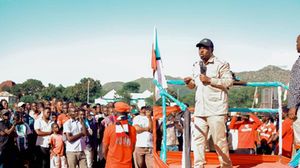
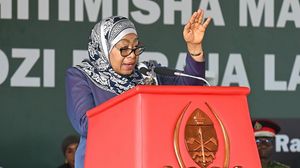
The national commemoration of Nyerere Day was held in Bariadi in Simiyu. This was accompanied by fading Uhuru Torch. The nation founding father Nyerere died on October 14 in 1999.
The just ended October marked two memorable historical events. First event was the commemoration of the death of Mwalimu Julius Nyerere, the founder of Tanzania nation.
The national commemoration of Nyerere Day was held in Bariadi in Simiyu. This was accompanied by fading Uhuru Torch. The nation founding father Nyerere died on October 14 in 1999.
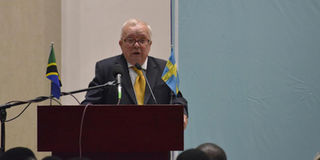
Secondly, as Tanzanians were pondering the direction of the country after surviving seventeen years without Nyerere, the same October, the Sweden embassy in Tanzania commemorated 30 years of the death of former Nordic prime minister and statesman Olof Palme who was assassinated in Stockholm in February 1986. The event was held at Julius Nyerere International Centre in Dar es Salaam on 24 October, this year.
The event that brought together diplomatics, politicians, varsity students and rights activists under the main discussants Gertrude Mongela, former President Benjamin Mkapa, Ambassador Christopher Liundi and former Sweden deputy minister and diplomat Bengt Save-Soderbergh didn’t focus on the merely the demise of the rights activist and politician Palme only but also on “exploring the past, present and future relationship between Tanzania and Sweden.”
It has been explained that the existing relationship between Tanzania and the Nordic country wasn’t influenced by raw materials, areas for investment or cheap labours, as it was the case for colonialists in different parts of Africa. The shared value between the two countries based on liberation of people in all sphere of life was a benchmark for the two parts to start to cooperate to realize this important goal.
“In exploring the past, present and future relationship between Tanzania and Sweden,” The Citizen correspondent Sauli Giliard interviewed the former Sweden deputy minister and diplomat who worked with Tanzania during the struggle for liberation of Southern Africa Bengt Save-Soderbergh.
For the first time, Bengt Save-Soderbergh arrived in the country in 1967, during the launch of Arusha Declaration. He shares his personal experiences in working with Mwalimu Nyerere and the history of the cooperation between Tanzania and Sweden.
What motivated Sweden to participate in the liberation movement in Southern Africa?
Bengt Save-Soderbergh: We were fighting for the right of people who were oppressed and not been given a proper chance to develop. So in doing so, we started in 1960’s to discover Africa for we didn’t know much about it. And one country which became so special to us was Tanzania.
The first person in contact was Mama Babro Johansson who came in Tanzania as a Swedish missionary in the late of 1940s. She then became a close friend of Mwalimu Julius Nyerere. She also became part of Mwalimu Nyerere’s political campaign for Tanzania to become independent. She also became a Tanzania citizen and when new policies were developed in 1960s she become member of Tanzania Parliament.
She had also had a contact in Sweden so when Nyerere was in the state visit in Sweden as early as in 1962, few months after Tanganyika attained its independence, is when big development started.
Nyerere’s ambition on development of Arusha Declaration and self –reliance is one aspect of it. But another thing that associated us in Tanzania and leadership here was a commitment to the liberation of the Southern Africa because we were also developing policy that we should support the liberation struggles against colonialism.
So how were you involved in the liberation struggles as far as Sweden foreign policy was involved?
Bengt Save-Soderbergh: I was involved from 1967 at a time of the launch of Arusha Declaration. I was working in the Swedish Foreign Ministry but also I was very active. I was not passive diplomat. So I was to deal with East Africa and particularly in Tanzania so I was here in many times.
Before the late Olof Palme came into power as prime minister, how was a relationship between Tanzania and Sweden?
Bengt Save-Soderbergh: Palme was working in the government and his predecessor Tage Erlander who was a friend of Mama Babro Johansson also. So Palme was there all the time. But our relationship started before Palme came into power. When Palme came to power he was excited about the cooperation between Tanzania and Sweden and he cemented it.
In his premiership, Palme visited in Tanzania and Zambia. Why he cooperated with Tanzania and Zambia? They were the two countries spotted in Africa which were extremely active in supporting liberation struggle in Africa. These were Tanzania and Zambia. There were other countries like Malawi, Congo and Zaire were not part of it.
These two countries (Tanzania and Zambia) were active and we decided to invest a lot of money in the struggle for liberation. The broad cooperation based on shared values.
Palme was a social democratic believer while Mwalimu Nyerere believed in Socialism and self-reliance, did they have common goal?
Bengt Save-Soderbergh: Yes, they have. They were not only sharing views but also actively working for the right of every person, to be free from the colonialism, and to have development based on equality and women’s rights.
Don’t you see Sweden’s Participation in liberation of Africa was based on the fact that it was taking advantage that when colonialists go; you cover the vacuum that would be left by them?
Bengt Save-Soderbergh: We were not aiming at that. We were cooperating in a friendship manner and solidarity. Off course, there are Swedish companies working here in Tanzania but that wasn’t the objective.
What were the challenges you encountered in your participation in Liberation of Southern Africa?
Bengt Save-Soderbergh: The problem was, for us, to get more countries to join the movement. We believed that democracy is a natural thing and people should have a right to democracy. In the beginning there was a little support from the western nations. And there was a cold war and the big powers had other priorities. They were not part of struggles against these racist regimes like in Rhodesia and South Africa and Portuguese colonialism empires.
But we wanted to convince others that this is a worst thing. We thought racism was a worse thing as Olof Palme used to says “in many ways racism is the worst kind of oppression. Why? Because you are branding a personal right from birth according to color of skin.” There is nothing you and me can do about colour of our skin. Why that should decide our future?...it’s nonsense. So we invested a lot to make independent struggles successful.
Do you think Tanzania misses Arusha Declaration after it was abandoned as the country is embarking in the middle income countries?
Bengt Save-Soderbergh: Arusha Declaration is still valid and you should be self-You reliant. Tanzania must build bigger economy than that it has today. And that can be done partly with international cooperation but fundamentally it has to be done in Tanzania. For that, you need it as Arusha Declaration is all about self-reliance.
So you should use resources and knowledge from other countries but Tanzanians have to build their country by themselves.
Why do we, Sweden and Tanzania, have shared values today? Your President (John Magufuli) is focusing very much on fighting corruption. And we share that policy and this is the area we can cooperate. We can share experience as you know fighting corruption is a very cumbersome task.