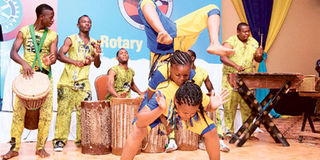
Parapanda Arts Theater Group showcase some of the country's playwrights work.
What you need to know:
What followed was a litany of offences read to him by the annoyed looking officers, which required him to cough up Sh 90, 000 as a fine.
While driving back from Mlandizi town inside his five-door Suzuki Vitara, Edwin Semzaba was told to pull over by some six traffic police officers manning the coastal lane.
What followed was a litany of offences read to him by the annoyed looking officers, which required him to cough up Sh 90, 000 as a fine.
He didn’t have the amount with him, so the officers confiscated his driving licence instead.
But while going through his personal details, one of the officers was struck by the name of the bearer.
“I walked scot free, one of the officers told me that he once used my book while preparing for a major exam and he passed the exam…it is Ngoswe which came to my rescue,” he says chuckling.
This is the kind of fame that hovers around this household name of the art industry, now plying his trade as a lecturer at the University of Dar es Salaam’s Department of Fine and Performing Arts.
It all began while Semzaba was a Form Two student at Kigoma Secondary School where together with some colleagues he had a lifetime experience of becoming a census officer. This was back in 1967 when Tanzania held its fourth national census.
Back then, the now defunct National Statistical Office of Tanzania also tasked secondary school students to take stock of fellow Tanzanians.
After being paid handsomely for their part in conducting the national census, Semzaba and his colleagues were told by their teachers to write stories about the experience they had on the field and read them out to the class.
“During that time some of us used the chance to have fun and go out with girls and as a result there were a lot of funny things happening which led to some students misplacing the tallies and others not getting accurate numbers,” recalls Semzaba.
It is from his experience at the time that Semzaba scribbled down his own version of the story, titled Hesabu Iliyoharibika, English for a distorted tally, which later came to be known as Ngoswe, Penzi Kitovu cha Uzembe a play published in 1996, which was widely used by secondary school students in the country as a recommended book.
According to Semzaba, he had decided to use the title Hesabu Iliyoharibika, but the play impressed publishers and radio stations and stuck with Ngoswe.
Thanks to its popularity, Ngoswe went to be republished three times by Swahili Publishers, Dar es Salaam University Press (DUP) and Nyambari Nyangwine.
“Ngoswe means a rat, and it was a name I used as a young boy…had it not been for the census I would not have written the play,” adds Semzaba inside his office at the department of Fine and Performing Arts.
Semzaba has produced countless works of arts, the most well know include novels like Marimba ya Majaliwa(2008), Funke Bugebuge(1999), Tausi wa Alfajiri(1996) and Tamaa ya Boimandaa(2002).
He also authored plays such as Kinyamekera(2014), Joseph na Josephine(2014), Mkokoteni (2014) and Sofia wa Gongolamboto(1985), which is an in depth look at colonial imperialism. Semzaba recalls the days when the nation’s arts scene was still in its infancy but also how writers were forced to adapt to colonial style literature.
“Those were the days when we would memorise and recite lines from the works of Shakespeare and laughed at the muted theatre performances of Charlie Chaplin.
The influence was more than just reading and watching colonial works, Semzaba and other writers even attended the Cambridge Summer Conference held in the United Kingdom, a platform which laid a cushion for spearheading colonialism within the arts in Tanzania.
He recalls how the British introduced the famous Little Theatre at the affluent St Peter’s area in Dar es Salaam.
“All this served the purpose of not making us conscious of our sufferings,” he says.
According to Semzaba, Kenya was the first country in the region to produce and publish plays. But Tanzania’s own theatre scene began to blossom during the Arusha Declaration in 1967 when the government asked writers to prepare works that were in line with the declaration such as Harakati za Ukombozi(Liberation Struggles) and Mashetani(Devils). But even then, many authors, Semzaba included, had a difficult time getting their work published.
“I had so many works ready to be published at the time, but it took me almost 18 years to publish Ngoswe because there was a shortage of publishers and manuscript editors back then, but now I have shifted my focus on grooming and nurturing other talents,” he says.
The international acclaimed playwright who was a recipient of the SIDA Children Adventure Book Competition in 2007, says what discourages him from producing more plays and novels is the lack of financial backing writers get: “An author never gets equal share of the spoils compared to the publisher once the work is out.”
He therefore urges the government to revisit the royalty agreement contract between publishers and authors, to better support the development of the local literature scene.
To put this in perspective, Semzaba says that out of Sh100, 000 tapped from a work, the publisher gets a lion’s share of Sh90,000 while the source of the work only walks home with Sh10,000.
Being a lecturer is also not without its challenges; Semzaba is saddened by the lack of interest in reading by most of the young people in Tanzania, even aspiring writers. “The current crop of writers don’t just read other people’s work…Shabaan Robert did take a creative writing class but learnt from reading other great writers,” explains Semzaba who admires writers from African Writers Series which include Elechi Amadi, Chinua Achebe and Ayi Kwei Armah.
“Many homes keep the Bible and Quran, but do not have other books to read,” he points out.
Semzaba is convinced that the state of Tanzania’s literature scene is nowhere near that of Kenya and Uganda. Especially when we consider that Tanzania still depends on the Russian Cultural Centre located at Sea View and Nkurumah Hall at UDSM to host theatre performances.
“We used to have the Bagamoyo Cultural Festival which attracted people from Europe and other parts of the world but that is no longer the case because key donors decided to pull out.”
He therefore encourages the government to reintroduce theatre performances, particularly theatre for development which he says has proven to be effective in societal transformation.