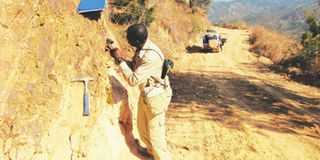
A mineral expert from the Geological Survey of Tanzania (GST)in uranium exploration assignment in Bahi District ,DodomaRegion recently.PHOTO|VALENTINE OFORO
What you need to know:
Government experts confirmed yesterday that preparations and logistics for the exploitation of the silvery-white metals were in full swing.
Dodoma. Residents of areas where uranium has been discovered in Bahi District, Dodoma Region are yet to be relocated even as the period set to start extraction approaches, The Citizen has learnt.
Government experts confirmed yesterday that preparations and logistics for the exploitation of the silvery-white metals were in full swing.
But Bahi residents who spoke to this paper maintained that they were not ready to vacate their area to pave the way for the mining.
Reports have it that their stand on the matter has been fueled by lobbyists and some politicians .
They are reportedly persuading them (residents) to prevent the government from mining the minerals on grounds that the extration would pose serious health effects to people residing near the mines.
“It’s a shame that despite being happy for being endowed with such rare minerals, some unscrupulous people have been convincing the residents to embargo the extraction for personal interests,” said one Energy and Minerals official who preferred anonymity.
Officials with the Geological Survey of Tanzania (GST) here said the minerals’ exploration task at the area was over and confided that almost the whole district is covered by black cotton soil which is a good sign for the availability of the minerals at the area. “The geological survey conducted at the area came out with results indicating that the area is endowed with abundant uranium and we have already developed a geological map for the area so as to give the investors a clear understanding over the potentials of the area,” said the Director for GST’s Laboratory Services, Miss Augustina Rutaihwa. For his part, the director for the geological service department at the GST, Mr Fadhil Mosses, said the extraction of uranium was very complicated compared to other minerals.
“The extraction of uranium is governed by international regulations because the minerals are primarily used for making weapons, therefore before starting the exploitation, the country must scrutinize carefully the company wishing to extract in order not to break international relations with other countries,” said Mr Mosses .
“He also urged the NGOs and politicians not to threaten Bahi residents that the extraction will affect their social life, adding: “Tanzania is having an advanced mining tools and awareness, therefore nothing bad will happen to anyone, though they must vacate the area when the extraction begins,” Mosses said.
He further stated that as per the governing rule, residents are supposed to stay at least more than 200 metres far from the uranium working sites.
“Despite having such abundant rich deposits, the flow of mining investors at the central zone corridor is still poor, most miners here are small –scale indigenous,” he revealed.
The economic performance of the central zone is still lackluster due to the area’s semi-arid climatic nature. If well managed and utilised, the mineral deposits at the zone could play a pivotal and promised role in eradicating poverty.
GST is a government agency responsible for acquiring, processing, interpreting, archiving and disseminating national geo-scientific data to various stakeholders for the purpose of promoting and attracting investment in different sectors, especially mining, since 1925, with its headquarters in Dodoma.