Government pushes for skills, innovation with Sh2.4tr plan
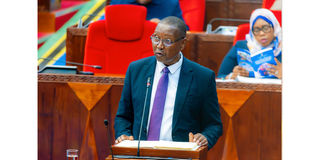
The Minister of Education, Science and Technology, Prof Adolf Mkenda, presents his docket’s 2026/27 budget proposals in Parliament in Dodoma yesterday. PHOTO | CORRESPONDENT
Dodoma. The government has unveiled a promising Sh2.4 trillion education budget for the 2026/27 financial year, placing higher education, research, science and innovation at the core of Tanzania’s long-term economic transformation agenda.
Presenting his docket’s 2026/27 budget proposals in Parliament yesterday, the Minister for Education, Science and Technology, Prof Adolf Mkenda, said the spending plan is designed to strengthen the implementation of the 2023 edition of the Education and Training Policy while preparing the country for the demands of Vision 2050 and a technology-driven industrial economy.
He said the ministry’s strategy for the coming financial year will focus on five major priority areas: implementation of education policy and curriculum reforms; expansion and improvement of vocational and practical training; enhancement of pre-primary, primary, secondary and teacher education; expansion and quality improvement of higher education; and strengthening research, science, technology and innovation to accelerate industrial development.
The ministry is seeking parliamentary approval for a total of Sh2.398 trillion for the 2026/27 financial year, including Sh1.696 trillion for development projects and Sh697.8 billion for recurrent expenditure.
If endorsed by legislators on today, the minister said the government will continue preparations for the rollout of compulsory 10-year education, including infrastructure expansion, teacher training and resource mobilisation ahead of the planned simultaneous enrolment of Standard Six and Seven pupils in January 2028.
The higher education agenda emerged as one of the strongest pillars of the budget, with the government outlining a robust plan to expand university access, student financing and international competitiveness.
Prof Mkenda said the government expects to coordinate admission of 180,000 undergraduate students into higher learning institutions in 2026/27. At the same time, beneficiaries of higher education loans will increase from 252,773 students in 2025/26 to 292,981 students in the coming financial year.
The government will also continue providing loans to 24,978 diploma students pursuing science and technical courses in an effort to address critical skills shortages.
In a significant move to nurture future innovators and technology experts, the minister announced an expansion of the Samia Scholarship programme for top-performing STEM students from 2,630 to 2,738 beneficiaries.
The government is also doubling the number of students sponsored under the Samia Extended Scholarship programme from 50 to 100. The programme supports outstanding science students to pursue undergraduate studies abroad in data science, interdisciplinary science and artificial intelligence.
Prof Mkenda said the government would continue strengthening learning environments in universities and science institutions through the construction and rehabilitation of lecture halls, laboratories, libraries and other facilities in 21 higher learning institutions under the Higher Education for Economic Transformation Project.
In a major push to modernise learning, the government plans to transform textbooks into interactive digital content featuring videos, audio, animation and virtual simulations, particularly in science, technology, engineering and mathematics subjects. The initiative is expected to support real-time assessments and improve digital learning experiences for students across the country.
Prof Mkenda also announced a broad expansion of technical and vocational education, saying the government will register 263 additional technical and vocational institutions and enrol 374,000 students in vocational and technical training programmes. The expansion is aimed at producing a highly skilled workforce capable of self-employment and meeting labour demands in strategic sectors such as energy, ICT and manufacturing.
To strengthen practical learning, the government will recruit and train more vocational teachers, build infrastructure in 30 vocational secondary schools, continue construction of 64 district vocational colleges and establish new polytechnic colleges in Mwanza, Kigoma, Mtwara and Morogoro after completing a similar institution in Dodoma.
The budget also places unprecedented emphasis on research and innovation as key drivers of economic growth and industrialisation.
Prof Mkenda said the government will increase funding for research and innovation projects from 80 to 109, targeting strategic sectors including climate change, the blue economy, fisheries, agriculture, water, health and industry.
In addition, higher learning and technical institutions will undertake 1,390 research projects across multiple disciplines ranging from education and health to technology, governance, environment and architecture.
To strengthen Tanzania’s global academic footprint, the government plans to publish 2,497 research papers in national and international journals to promote knowledge dissemination and ensure research findings contribute directly to solving socio-economic challenges.
The minister said the government will also strengthen laboratories in five research and development institutions to serve as national reference centres for industrial innovation and applied research.
As part of efforts to commercialise innovation, the government will expand the Samia Innovation Commercialization Fund to support more innovators and startups while equipping five Folk Development Colleges with innovation hubs.
Prof Mkenda said stronger collaboration between research institutions, universities and industries would be prioritised to ensure scientific discoveries and innovation contribute meaningfully to Tanzania’s industrial economy and implementation of Vision 2050.
Register to begin your journey to our premium contentSubscribe for full access to premium content