Government tightens grip on donor-funded projects under Dira 2050
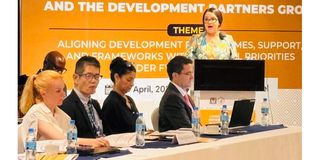
Permanent Secretary in the President’s Office (Planning) and Executive Secretary of the NPC, Dr Tausi Kida, speaks during a joint meeting between the Commission and development partners on the implementation of the National Vision 2050. PHOTO | COURTESY
Dar es Salaam. The government is moving to tighten oversight of donor-funded projects, signalling a major shift in how development assistance is managed as the government begins implementing its ambitious Dira 2050 strategy aimed at transforming the country into a $1 trillion economy.
Officials said all development programmes, particularly those financed through external partners, will now be subjected to stricter scrutiny under the National Planning Commission (NPC), a move intended to ensure alignment with national priorities and improve accountability in project implementation.
Speaking during a meeting between the government and development partners convened by the President’s Office–Planning in collaboration with the National Planning Commission yesterday, Permanent Secretary in the President’s Office (Planning) and Executive Secretary of the NPC, Dr Tausi Kida, said the new framework marks a departure from fragmented planning towards a more coordinated and results-driven approach.
“All development frameworks, grants, and projects will have to pass through the Commission for review to ensure alignment and coherence with national priorities,” she said, noting that early-stage engagement with the NPC would be critical in avoiding delays and inconsistencies during implementation.
The shift comes as Tanzania transitions from designing its long-term development blueprint to executing it, with authorities emphasising the need for tighter coordination and efficient use of resources.
Launched in 2025, Dira 2050 outlines Tanzania’s ambition to become a high-income, industrialised economy with a projected size of $1 trillion, nearly 10 times its current output.
The plan also targets zero poverty, universal access to quality education, improved healthcare, and a life expectancy of 75 years.
Dr Kida said, unlike previous long-term strategies, the new vision is backed by fully developed implementation instruments, including a long-term perspective plan and the Fourth Five-Year Development Plan, both expected to take effect from July 1. “For the first time, we are starting with a vision whose implementation frameworks are already in place,” she said.
“This gives us a stronger foundation to translate ambition into measurable outcomes,” added Dr Kida.
Government officials argue that tighter oversight of donor-funded projects is essential to achieving these goals, particularly in ensuring that external support complements domestic priorities rather than operating through parallel systems.
Permanent Secretary in the Ministry of Foreign Affairs and East African Cooperation, Dr Samwel Shelukindo, underscored the importance of aligning development partner interventions with national plans, describing such coordination as key to delivering “inclusive and sustainable development outcomes.”
He said Tanzania’s economy remains resilient, with growth averaging between 5.2 and 5.6 percent, supported by reforms and sustained collaboration with development partners.
Key sectors such as agriculture, energy, and manufacturing continue to expand, while major infrastructure projects are positioning the country as a regional trade hub.
However, development partners cautioned that the implementation phase will unfold in a challenging global environment marked by declining official development assistance (ODA), rising energy costs, and increasing geopolitical uncertainties.
United Nations Resident Coordinator Susan Namondo said development partners remain committed to supporting Tanzania’s ambitions but emphasised the need for clarity on priorities and sequencing of reforms.
“We are all here in the spirit of partnership and alignment behind Tanzania’s long-term ambition. But as we move from vision to implementation, it will be important to understand where transformation is expected to happen fastest and how partners can add the greatest value,” she said.
She also pointed to growing constraints in global development financing, noting that partners are operating under tighter budgets while facing competing priorities in their home countries.
Echoing similar concerns, Ireland’s Deputy Head of Mission, Suzanne Keating, said reductions in ODA are already being felt across developing economies, affecting governments, multilateral institutions, and civil society organisations.
“We are seeing significant shifts and reductions in funding from key partners,” she said, adding that aid must now be used more strategically to catalyse broader transformation rather than fund isolated interventions.
Despite these pressures, both government and development partners expressed optimism that stronger coordination mechanisms and increased reliance on private sector investment could help bridge financing gaps.
Dr Kida said the private sector will play a central role in driving economic transformation, particularly in industrialisation, trade, and innovation. The government is also implementing tax and regulatory reforms aimed at improving the business environment and attracting investment at scale.
“We are diversifying our sources of financing, including foreign direct investment and trade. But we also need to strengthen our institutional capacity and ensure that every intervention delivers measurable results,” she said.
Development partners welcomed the emphasis on accountability and alignment but called for regular dialogue to sustain momentum and address emerging challenges.
“There is value in meeting more frequently to assess progress and adjust where necessary,” Ms Namondo said, suggesting quarterly engagements to enhance coordination among stakeholders.