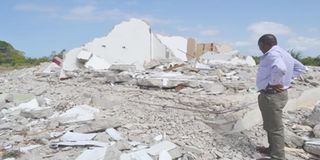
A resident of Amani Gomvu Village at Somangila Ward in Kigamboni, Temeke District, looks at the debris of one of several demolished houses.
What you need to know:
“I was evicted from my farm in 2013 to make way for the development of low-cost housing for retired army officers,” says the father of six.
Dar es Salaam. Juma Abdallah, a resident of Kigamboni, has lost his 20 hectares of farm crops, including cashew and coconut trees. The resident of Amani Gomvu Village is so devastated that he sees the end of his life.
“I was evicted from my farm in 2013 to make way for the development of low-cost housing for retired army officers,” says the father of six.
His children have dropped out of school for lack of fees, his house was razed to the ground and he has not received even a single cent of compensation. The farmer in Somangila, some 26 kilometres south of Kigamboni ferry, adds: “I am living like a refugee in my own country. I cannot even freely enjoy my conjugal rights with my wife since we moved to our parents’ home, where we live in one small house.”
In Somangila, the story is told of Hamidu Nassoro Ubegete, an old man who died in June 2014 of high blood pressure that is said to have developed after his five houses and a mosque were demolished in one night. Abdallah is among over 200 residents of Somangila Ward in Kigamboni in Dar es Salaam’s Temeke District who have been evicted to make way for the construction of what was initially described as a low-cost housing project for military officers who had retired from the Tanzania People’s Defence Forces (TPDF).
But Somangila now looks like a war-torn zone, with debris from demolished houses, and residents have sought refuge with relatives in areas outside the project area covering more than 500 hectares of land.
The newly-appointed Minister for Lands, Housing and Human Settlements Development, Mr William Lukuvi, says those affected should make their complaints in writing to enable him to get the full picture of the situation.
“People in the area should write to me on what has transpired so I have a starting point,” says the minister. He will also involve the Commissioner for Lands and the ministry’s lawyer on their return from an official trip abroad.
Residents who claim to have been evicted from the area told The Citizen last week that the whole thing started in 2007, when former Dar es Salaam Regional Commissioner Abbas Kandoro called a meeting at Amani Gomvu Village and announced that the government wanted to build an oil refinery in the area and would need 200 hectares of land for the project.
The project never got off the ground, though, as the local villagers banded together and called in the National Environment Management Council (NEMC).Then it all started again in 2012 with a new project—low cost housing for retired TPDF employees and other civil servants, according to 70-year-old Khadija Chande Msomi.
“My six and a half hectares of cashew and coconut trees have been grabbed,” says Msomi, a mother of 11 who also has several grandchildren. My house was razed too. I was not given a single cent as compensation.”
“Once again under the guise of ‘government’ so as to intimidate us and take our land with minimal compensation, the (Dar es Salaam) Regional Commissioner, Mr Said Meck Sadick, went to China and managed to get funding for the project from a company called AVIC,” said another resident standing near the debris of his demolished house.
He added: “Now it is actually an upmarket housing development for the general public and not retired army officers,” he said, adding that the housing development which was being executed by a Chinese company called AVIC International Real Estate included Ngaramia Forest Reserve, which is a gazetted reserve.
In his response to these claims, Mr Sadick says he knows nothing about AVIC. “I always go to China on government business missions,” he says. “I have gone there more than 20 times but I have never met AVIC.”
He advises people who have been evicted without compensation to go to court to seek redress. He denies the claims that he is one of those who have bought a house at AVIC town and dismisses such talk as rumour-mongering. “Go search in the register for my name,” he added. “Are there houses there?”
Amani Gomvu villagers say they have by-laws to preserve the trees and retain the crystal clear water in the Ngaramia Forest Reserve but they now wonder whether the reserve, which is the source of an underground river, is within the AVIC development plan.
“The Chinese, I am told, want to dredge the swamp, dam up the river and create the water/dam shown in the artist’s impression,” says Mr Sadick, “This will undoubtedly ruin this vital water source.”
According to Ramadhani Yusuf Ubegete, 45, Ngaramia was the only water source left when there was a terrible drought in the distant past and the people would walk many kilometres to get drinking water.
He adds: “We have been affected economically. I have failed to pay school fees for my six children and they no longer go to school—we don’t even have a place to bury the dead.
If there is the rule of law and good governance in this country, we should be given our land back.”
The Citizen recently visited what is now called AVIC town and found a sales centre for newly-built houses going for between $100,000 and $400,000 for a single house, depending on quality and size.
“We are selling luxury villas and bungalows to willing buyers,” says Angela Ajuaye, marketing executive for AVIC Coastland Development. The firm intends to build 158 ordinary houses, 111 bungalows and 47 villas in an area covering 583 hectares.
“You can make a down payment of 20 per cent of the price of one housing unit followed by four installments,” she says, “or you can pay through a mortgage at CRDB Bank or the Bank of Africa.”
Two weeks ago, AVIC Coastland Development opened a sales point at Mlimani City Mall in Dar es Salaam, where classy brochures and a map of the area were on display.
This newspaper emailed questions to Li Jiayin, AVIC International Real Estate’s manager but he has not given answers in the past three weeks despite reminders by phone.
However, a visit to AVIC town website www.avictown.co.tz found an article entitled: Avic town—Luxury landmark in Kigamboni. It quotes Li explaining the development project.
According to the article, AVIC town plans to deliver two to five-bedroomed houses. The gated villas and bungalows are in compound sizes of up to 1,200 square metres.
AVIC town is a large-scale luxury villas and bungalows project which will be developed in five phases and, when completed, will be the largest residential community in Dar es Salaam, according to the article.
“This development is not just a residential project, but a middle class and high-end gated community designed to foster a superlative, luxurious lifestyle with outstanding sports and commercial facilities,” Li is quoted as saying. “Our goal is to make the development a vibrant and independent town, as well as a safe and comfortable community to raise a family.”
The town is reportedly designed with diverse modern amenities including a tarmacked road network, pharmacy, kindergarten, retail stores, supermarkets, restaurants, cafes, golf course, swimming pool, gym, tennis court, basketball court, football field and children’s play places.
It will also reportedly be the only project in Kigamboni on this mammoth scale that has beautiful landscaping, parks, and green areas that account for more than third of its total surface area, it says.
Other facilities include 24-hour security and the main entries will feature sophisticated security controls for pedestrians and vehicles, including automatic swipe cards. Visitors will be registered before they are allowed in.
Says Li, without clarifying: “Different from apartment lifestyle, the community will enjoy quality lifestyles with privacy in gated compounds. So, at AVIC town not only do you get a house but also land.”
Negotiations continue with various banks to secure low mortgage interest rates for prospective customers. Mr Edward Chuwa, a private advocate at Chuwa and Company Advocates, says some Amani Gomvi villagers intend to sue the Commissioner for Lands, the Tanzania Investment Centre and the Attorney General over their eviction.
According to the lawyer, the Temeke Municipal director wrote a letter dated November 15, 2012, to the Somangila Ward executive secretary informing him that the villagers’ land was valuated and compensation was paid according to the law.
“In fact, there was no legal procedure that was ever followed for compulsory acquisition and there was no compensation which was paid to our clients (villagers) and there has never been land acquisition in law,” says the lawyer.
According to him, the letter claimed that AVIC was supposed to build houses for army workers. Contrary to claims made in the letter, says the advocate, AVIC Coastland Development Company has trespassed on the villagers’ land, demolished premises, fenced the area and started construction of houses which “they are now advertising for sale to any person, including government officials, and not the army officers.”
Mr Chuwa says his clients were offered rights of occupancy after they paid for the survey of the pieces of land that they have been evicted from.
He says the Ministry of Lands, Housing and Human Settlements Development ordered the Temeke Municipal Council surveyor to remove all beacons on his clients’ land without notice.
The Temeke Municipal Acting Director, Mr Waziri Bakari Kombo, says he believes the government cannot evict them without compensation. “AVIC, a foreign company, cannot grab land without compensation,” says Mr Kombo, adding that local residents should go to court to seek their rights if they feel aggrieved.
Temeke municipal authorities were not involved in compensation of the villagers, he said. That could only have been done by the Ministry of Lands, Housing and Human Settlements Development.
Mr Albert Baraba, head of Temeke’s Department of Urban Planning and Natural Resources, says some of the villagers were compensated before they were evicted and sold the land to unsuspecting buyers who are complaining today. “The major purpose was to grant our clients’ land to a foreign company dealing with real estate business called AVIC Coastland Development Limited,” says Mr Chuwa.
He adds that the cancellation of the survey was cancelled and the beacons removed irrespective of the fact that the land in dispute was already offered and several rights of occupancy were already granted to various citizens and could not be revoked just like that.
The cancellation letter was signed on behalf of the director while knowing that it was only the president who can revoke the right of occupancy as provided for by the Land Act of 1999, he says.
On March 19, 2012, the Commissioner for Lands, acting under political pressure, designated the land at Amani Gomvi for investment.
The commissioner gave the land to Tanzania Investment Centre (TIC) under certificate of title number 120678, plot number 265 Amani Gomvi without any legal procedure and TIC granted the land to the Chinese company on May 4, 2012, claims Mr Chuwa.
In a letter dated March 7, 2012, the Temeke municipal director reportedly informed the municipal surveyor that local people had been compensated for the compulsory acquisition of land—which the lawyer dismissed as false.
He says the letter claimed that the villagers had surveyed the land on their own, while in fact all surveys were conducted and registered by the Ministry of Lands, Housing and Human Settlements Development and the ministry could not disown them only for the purpose of assisting few individuals.
Mr Chuwa says the only authority to revoke a title deed is the president.