Tanzania advances independent exploration with high hopes for domestic oil discovery

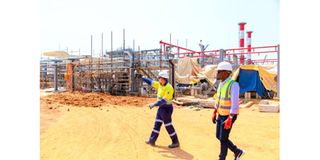
The manager of the fourth EACOP oil receiving and pumping station (PS4) on the Tanzanian side, Mr Camali Maluli (left), briefs Tanzania Petroleum Development Corporation (TPDC) investment director, Mr Derick Moshi, on the facility on Saturday, August 8, 2026. PHOTO | AMINA MBWAMBO
Geita. Tanzania, through the Tanzania Petroleum Development Corporation (TPDC), is at a crucial stage of oil exploration in areas where it is conducting operations independently, confident that it will soon be able to announce positive results regarding the presence of oil in the country.

This step is part of the government's strategy to start deploying its domestic capability to search for and develop oil and gas resources, rather than relying solely on external expertise.

This was stated on Saturday, August 8, 2026, in Mbogwe District, Geita Region, by TPDC director of investment, Mr Derick Moshi.

TPDC and the Ministry of Energy inspected the fourth Pumping Station (PS4) on the Tanzanian side of the East African Crude Oil Pipeline (EACOP), running from Hoima in Uganda to Chongoleani in Tanga Region, where construction progress has reached 88 percent.

Furthermore, he explained that the corporation is currently continuing with data collection, processing, and interpretation of geological and geophysical information in the exploration area, a measure aimed at enabling Tanzania to confirm the presence of oil and ultimately develop it for national benefit.

“We fully believe that after a short while we will step forward and announce that we have been able to discover oil sources. Those are our dreams, and that is the major effort that TPDC and the country as a whole are making,” said Mr Moshi.

He stated that experience gained from implementing major oil and gas projects has enabled Tanzania to reach a stage where it can begin executing certain exploration activities using its own capacity.

A team from the Tanzania Petroleum Development Corporation (TPDC) and the Ministry of Energy inspects the fourth EACOP oil receiving and pumping station (PS4) in Lubeho Village, Nyakafuru Ward, Mbogwe District, Geita Region on Saturday, August 8, 2026. PHOTO | AMINA MBWAMBO

He said TPDC's goal is to ensure Tanzania gains the capability to explore, discover, and develop its own resources, a step that will allow the nation to fully exploit opportunities available in the oil and gas sector.

He noted that should oil be discovered, the subsequent step will involve evaluating it, developing it, and ultimately turning it into a resource capable of generating revenue for the nation.

“We as Tanzania can explore our own resources and develop them for the benefit of Tanzanians within this major oil and gas economy,” he said.

Additionally, he stated that the construction of EACOP could prove hugely significant during the period when Tanzania begins producing its own oil, given that the pipeline can provide the infrastructure to transport oil to markets.

He noted that the presence of such infrastructure could reduce time and costs associated with developing new oil projects once Tanzania reaches a commercial stage.

“Connecting with this project, we clearly see that as this project is implemented, there will be a transport backbone. Therefore, it further incentivises that even when we strike oil, the infrastructure is already in place,” said Mr Moshi.

He mentioned that TPDC has also been collaborating with Veta and Sido to prepare young people with skills required for major engineering, industrial, and energy projects.

He emphasised that EACOP is not merely a crude oil transport project, but also part of building Tanzania's infrastructure, expertise, and capability to participate fully in the oil and gas economy.

EACOP acting Tanzania manager, Mr Jofrey Mponda, said construction of the station has reached 88 percent and is expected to be completed before the end of October 2026.

He said EACOP has been a source of employment for Tanzanians, with statistics from the fourth station showing a high level of local participation, where out of 1,121 workers at the site, 909 are Tanzanians, equivalent to 82 percent.

“The total number of workers present here executing duties is 1,121. Among those, 909 are Tanzanians,” said Mr Mponda.

Some Tanzanians working at the station, including Mr Paulo Chasama, said he joined the project in 2024 as a mechanic assistant, but through experience and training received, he has gained the ability to perform various technical tasks.

“I entered as an assistant mechanic, but currently I possess substantial knowledge and understanding of how to perform tasks well, and now I am a technician here; I am grateful for this skill, so even when the project ends, I can self-employ and support my family,” he said.

Mr Ismail Masolwa said the project has allowed citizens to engage in various activities and earn an income to run their families.

“This project has benefited us and enabled us to engage in various sectors. We earn an income to support our families,” said Mr Masolwa.