Tanzania Health minister orders return of state-sponsored doctors amid maternal, infant deaths concern
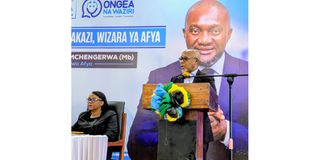
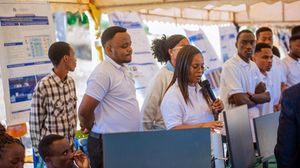
The Permanent Secretary of the Ministry of Health, Seif Shekalaghe, speaking with health workers in Mwanza during their general staff meeting. PHOTO | SAADA AMIR
Mwanza. The Minister for Health, Mr Mohamed Mchengerwa, has ordered health workers trained at government expense to return to public service, as he raised alarm over persistently high maternal and infant deaths in the country.
Opening the Health Ministry Workers’ Council meeting in Mwanza on May 3, 2026, the minister called for improved service delivery grounded in compassion, discipline, accountability and professionalism.
“What kind of Ministry of Health do we want? One of imposing buildings without a human touch? Or one grounded in compassion, discipline, professionalism and integrity… one that sees a patient not as a file, but as a human being?” he posed.
Mr Mchengerwa said Tanzania continues to record about 57,000 newborn deaths annually, alongside more than 2,330 maternal deaths, describing the figures as unacceptable.
“We cannot celebrate such numbers… the reality is that every year more than 2,330 mothers die due to negligence, lack of nearby services, or poor-quality care in our facilities. Sometimes medicines are unavailable, or we delay assisting them during childbirth,” he said.
“Over 57,000 children die in our facilities annually due to negligence, delays in attending to pregnant women, and lack of critical services, including emergency neonatal care,” he added.
He stressed that negligence remains a key factor and urged health workers to take collective responsibility to drastically reduce the figures.
“Let us strive to bring these numbers down to single digits. It is possible if we commit together,” he said.
Incentive framework
The minister said the government has initiated measures to improve working conditions through a special incentive scheme aimed at boosting morale and efficiency.
“As part of efforts to improve the working environment, the ministry has submitted a draft incentive framework to the Chief Secretary, President’s Office – Public Service Management and Good Governance, for further analysis and advice,” he said.
He said that he had also written to President Samia Suluhu Hassan outlining the challenges faced by health workers at various levels, including specialists, nurses and other cadres.
According to him, the scheme will help recognise and reward dedicated workers, particularly those serving in difficult environments.
“A worker who is exhausted, lacks tools, and feels unfairly treated in promotions or delayed in receiving arrears cannot deliver services with the expected level of commitment,” he said.
Local production, procurement
Mr Mchengerwa emphasised the need to strengthen domestic production of medicines and medical supplies, warning that reliance on imports exposes the country to global shocks.
“A nation that does not build its capacity to produce medicines and medical supplies will remain hostage to pricing, logistics and global uncertainties,” he said.
He directed that procurement through the Medical Stores Department (MSD) should prioritise locally produced goods and warned against violations of procurement procedures.
“We will not tolerate decisions that undermine locally produced medicines by opting for imports without justification,” he said.
Mental health focus
The minister said the government will intensify efforts to expand access to mental health services by bringing them closer to communities.
“Mental health must be given the attention it deserves… a person may appear physically fine but be mentally overwhelmed,” he said.
He called for the 2026/27 budget to prioritise decentralising mental health services beyond referral hospitals.
“Mental health is not a luxury for urban areas—it is a necessity for every family, school, village and workplace,” he added.
Universal health insurance
On universal health insurance, Mr Mchengerwa said health workers must prepare for its implementation, noting that it goes beyond issuing cards to strengthening systems.
“This is not just about cards—it is about system capacity. Infrastructure must be ready, ICT systems must be robust, medicines available, and human resources sufficient,” he said.
Patient care, conduct
The minister stressed that improved infrastructure alone is insufficient without respectful communication and humane treatment of patients.
“Modern buildings without respectful language are meaningless… advanced machines without compassion are just metal. A hospital that shines but intimidates patients through harsh language, discrimination or negligence has failed its duty,” he said.
He warned against abusive language, corruption, unnecessary delays and discrimination in service delivery.
“When a patient comes to us, they carry pain and fear… our words can be their first remedy or a second wound. Let us choose words that heal,” he said.
Return of state-sponsored workers
Mr Mchengerwa directed that all health workers who benefited from government sponsorship must return to serve in public institutions as required by their contracts.
“Those educated at government expense must return to serve the government… some complete their Master’s and proceed to PhD studies, which is fine—but once they finish, they must return. Instead, some take unpaid leave and fail to return, contrary to regulations requiring at least three to four years of service,” he said.
He noted that some specialists have opted to work in private facilities rather than government hospitals and said a list of such individuals is under review.
Leadership concerns
The minister also raised concerns about abuse of power, intimidation and mistreatment of junior staff in some facilities.
“Bullying is not leadership, humiliation is not discipline, and threats are not supervision. A leader who cannot lead without hurting others has not matured in leadership,” he said.
He said the ministry will strengthen reporting systems to address grievances and ensure accountability.
“All workers have the right to operate in a respectful, safe and dignified environment. A true leader empowers others to stand firm, not tremble,” he said.
Earlier, the Permanent Secretary in the Ministry of Health, Dr Seif Shekalaghe, said the two-day meeting would review the 2026/27 budget framework, assess past performance and propose measures to improve health services and staff welfare.
Register to begin your journey to our premium contentSubscribe for full access to premium content