Tanzania, Uganda line up major infrastructure projects as oil exports near
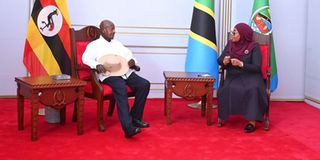
President Samia Suluhu Hassan, holds talks with Ugandan President Yoweri Museveni, shortly after his arrival at State House in Dar es Salaam on February 7, 2026. PHOTO | STATE HOUSE
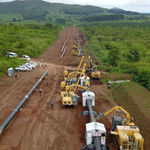
Dar es Salaam. Tanzania and Uganda are preparing to begin exporting crude oil to the international market in July, a move leaders from both countries say will serve as a catalyst for a wider programme of major infrastructure, energy and transport projects aimed at strengthening economic cooperation.
Speaking on Saturday at State House in Dar es Salaam, President Samia Suluhu Hassan said the first shipment of crude oil transported from Hoima in western Uganda through the East African Crude Oil Pipeline (EACOP) to the Port of Tanga in Tanzania is expected to depart in July, marking the operational phase of one of East Africa’s most ambitious cross-border investments.
President Hassan said the start of oil exports was not an isolated milestone but part of a broader framework of cooperation being built by the two countries to deepen long-term bilateral ties.
She made the remarks after holding talks with her Ugandan counterpart Yoweri Kaguta Museveni, who arrived in the country earlier in the day for a one-day working visit.
The two leaders first held private discussions before meeting their respective ministerial teams and later addressing the media.
The visit marked President Museveni’s first foreign trip since his re-election in Uganda’s January 15, 2026 General Election, which secured him a seventh term in office since taking power in 1986. It was also the first visit by a foreign head of state to Tanzania since the October 29, 2025 General Election that returned President Hassan to office.
President Hassan said discussions with President Museveni and their teams focused largely on energy and transport infrastructure, reflecting a shared ambition to accelerate economic growth through improved connectivity.
In addition to the crude oil pipeline, the two sides discussed the construction of a natural gas pipeline from Tanzania to Uganda, as well as a refined petroleum products pipeline from Uganda to Tanga.
She said progress on EACOP had reached an advanced stage, raising confidence that the first tanker would leave Tanga in July.
“We thank God for the progress we have made. The first ship is likely to depart from Tanga carrying crude oil to the market. There are other issues we are still working on,” President Hassan said.
Ports and logistics cooperation also featured prominently in the talks, underscoring Tanzania’s role as a key maritime gateway for landlocked countries in the region.
President Hassan said the two countries discussed expanded use of the ports of Dar es Salaam, Tanga and Mtwara to support trade flows and energy exports, particularly as oil shipments begin. She noted that investments in port infrastructure were intended to match growing regional demand and ease logistical bottlenecks.
On rail transport, she said Tanzania briefed Uganda on the proposed railway linking Tanga to Musoma, which would allow cargo to connect to Uganda via Lake Victoria.
She also outlined progress on the standard gauge railway (SGR) from Isaka to Rusaunga, adding that Tanzania had requested Uganda to extend the line to Murongo on its side of the border to strengthen regional rail integration.
“These rail links are critical in reducing transport costs, easing the movement of goods and supporting trade between our two countries,” she said.
President Hassan said the two governments had continued to work on removing non-tariff trade barriers, noting that bilateral trade had expanded significantly in recent years. She acknowledged, however, that some operational challenges remained, often linked to actions by officials at lower levels.
Beyond infrastructure and trade, the talks also covered regional and international diplomacy.
President Hassan thanked President Museveni for Uganda’s decision to withdraw from the contest for the United Nations Security Council seat allocated to East Africa, paving the way for Tanzania to assume the position. She said Tanzania would, in turn, support Uganda’s bid for a leadership role within the African Union.
Regional security, particularly in the Great Lakes region, was also discussed.
President Hassan said Tanzania was ready to support President Museveni, who currently chairs the bloc of Great Lakes countries, in efforts to initiate dialogue aimed at restoring stability in conflict-affected areas.
“As chair of the Great Lakes region, President Museveni has a strategy to initiate dialogue to bring peace. Tanzania has assured him of full support and readiness to assist in whatever way is necessary,” she said.
For his part, President Museveni said his talks with President Hassan focused on the need for African countries to deepen strategic and economic cooperation to safeguard development and security.
He said Africa’s liberation struggles were anchored on three core objectives: achieving political independence, delivering economic development through production of goods and services, and ensuring strategic security.
“After independence, we need to combine our efforts. There are emerging threats in our region, and it is important that we work together to address them,” President Museveni said.
He stressed that regional integration was no longer a political choice but an economic and security necessity, warning that African countries risk remaining vulnerable if they continue to operate in isolation.
Referring to the 1965 Kampala Declaration, President Museveni recalled that East African countries once agreed on a coordinated industrial development framework, under which Tanzania would focus on tyre production, Uganda on textiles and Kenya on other manufacturing activities.
“We need to return to such a structure. I do not know what went wrong, but this kind of coordination is essential if we are to build strong economies,” he said.
President Museveni said regional cooperation should also be viewed through a security lens, noting that instability in one country often spills over into neighbouring states.
He warned African nations against repeating historical mistakes, saying the continent was once easily dominated because its leaders failed to recognise and prepare for external threats.
“Some of our traditional leaders saw danger coming but did nothing to defend themselves. We must not repeat that mistake,” he said.
He added that African countries must unite diplomatically and economically, use their natural resources strategically and build collective strength to determine their own future without undue external influence.