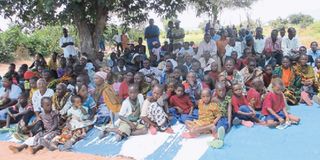
Mpamantwa villagers listen to a Swiss Embassy official during the handover of a water project for their dispensary in Bahi District, Dodoma, on February 21, 2015. PHOTO | FILE
What you need to know:
Many health centres and dispensaries had no proper bathrooms, latrines and areas of disposing of placentae in 2013. Mothers who were forced to go there with their own water containers
Dodoma. Forty-two per cent of Dodoma Region’s primary heath facilities had no reliable water supply up to 2013.
That was a serious problem to 186 of 402 such facilities.
The situation affected mothers who were forced to go there with their own water containers.
At most health centres and dispensaries, there were no proper bathrooms, latrines and areas of disposing of placentae.
In 2013, the Swiss Agency for Development and Cooperation launched the Health System Strengthening Project to improve the situation.
The agency released $8,397,392 for implementing a five-year Maji Kwa Afya ya Jamii (Mkaji) Project to supply water in the health facilities.
The agency picked Steun Inzake Medische Aangelegenheden Voor Inheemschen’ (Simavi) — a Dutch NGO — as the project’s chief implementer.
Simavi was founded in 1925 by two physicians — John van der Speak and H. Bervoets — to assist health institutions in the former Dutch East Indies
“The project aims at reducing risk of transmission of communicable diseases and during patient care,” said Mkaji programme manager Thea Bongertman.
A survey on how best to implement the project as well as on drafting viable working methods in cooperation with local government leaders was undertaken in 2013.
Training was conducted for health workers and villagers.
According to Ms Bongertman, 100 primary healthcare facilities in all eight districts in the region were selected for the project.
The selection was based on the extent of the facilities’ vulnerabilities as budget limitation was highly taken into consideration.
According to her, 38 primary healthcare facilities have aso far benefited from the project.
“We have supplied reliable clean, safe water to each of the 38 health facilities. There are good bathrooms, delivery rooms and latrines. We have also installed hand-washing basins and constructed areas of disposing of placentae.”
Training also has been conducted health workers and villagers to ensure the sustainability of the project when it ends in March 2019.
“We have been conducting training to promote hygiene in all facilities. Training sessions have been undertaken for nurses to professionally care mothers and newborns,” said programme officer Sosthenes Gabriel.
Other training sessions have been about operational and maintenance of water, sanitation and health infrastructure; financial management to health staff and community members.
“Behavioural change is facilitated through training of health facility staff, village health workers as well as traditional birth attendants on hygiene matters,” according to him.
“Dodoma Regional Medical Officer Charles Kiologwe has played a great role to ensure the project success. He has given the greelight for district medical officers and the regional health management team to give is technical support,” said Mr Gabriel.
Ms Bongertman said the project woud be expanded to cover the remaining 62 health facilities.
This is important taking into the account the fact that the government is relocating its seat from Dar es Salaam to Dodoma.
“We are determined to ensure that services in the remaining 62 health facilities in all eight districts are improved. We hope that that would be done as scheduled,” Mr Gabriel affirmed.
According to Unicef, Tanzania has been making considerable progress in the reduction of child mortality.
Under-five mortality rates continue to drop from 112 deaths per 1,000 live births in 2005 to 81 in 2010. The deaths of infants under one year also decreased from 68 to 51 per 1,000 live births over the same period.
Despite improvements, about 390 children under five die every day of mainly preventable and treatable conditions.
Usaid says while Tanzania has made gains in reducing under- five mortality, progress has been slower in terms of maternal and neonatal deaths.
“Maternal mortality rates remain high at 556 deaths per 100,000 live births due to challenges such as inadequate quality of services, lack of access to emergency obstetric care, limited ability of women to independently access health services, and direct causes such as postpartum hemorrhage. Neonatal deaths, which continue to comprise a significant proportion of under-five deaths, highlight the importance of responding to major causes such as infection, asphyxia, HIV, malaria, and congenital syphilis,” said its report.