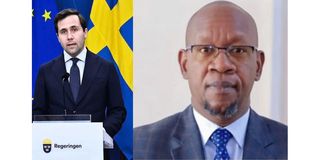
The Swedish Minister for International Development Cooperation, Benjamin Dousa, on December 5, announced the Swedish Government's decision to cancel aid to five countries - Tanzania, Mozambique, Zimbabwe, Liberia and Bolivia - after reviewing policy priorities and security challenges.
However, in making the announcement, he accused the countries of being stuck in socialism and failing to progress. The Tanzanian Ambassador to Sweden, His Excellency Mobhare Matinyi, responds by describing the achievements that Tanzania has attained in economic development in the last 60 years.
The Swedish government on December 4, after reviewing its foreign policy priorities and security challenges, announced a decision to phase out its bilateral development cooperation with five countries before the end of 2026, effectively ending the decades-long aid arrangement.
One of the affected countries is the United Republic of Tanzania, a country that has maintained cordial relations with Sweden going back 62 years.
The sharing of social democratic values between the two countries was the mother of this unique relationship. Social democrats believe in social justice, freedom, equality, human dignity and solidarity within a framework of democracy and state intervention in the midst of capitalism to enable a welfare state to flourish.
However, while Sweden was a multiparty democracy with a capitalist welfare state, Tanzania chose a single party democracy with an African brand of socialism, Ujamaa, which emphasised on self-reliance. Sweden then assumed the tutorial role of cooperative movements for Tanzania at that time.
Noticeably, the two countries were poles apart in economic development as Sweden, with 7.5 million people, had a GDP of $17.33 billion in 1961, running a strong industrial economy while Tanzania with 10.3 million people had a GDP of $2.83 billion depending mainly on an agrarian economy.
Sweden, therefore in 1963, saw the need to support Tanzania, by then Tanganyika before uniting with Zanzibar in 1964 to form Tanzania, because the new country had demonstrated a clear development vision under President Julius Nyerere.
The recent announcement by the Swedish government, inadvertently, elicited a narrative that completely misrepresented Tanzania and the entire gains of this iconic cooperation. It claimed that the said countries had been “characterised by socialism” for many decades and as a result “had not developed”.
Let me be very clear from the outset; the above assertion does not align with Tanzania in any form or shape, even from sheer imagination.
Let us look at the facts: In the early 1960s Tanzania had only one university college, but today it has 36 registered universities and 16 university colleges. Sweden, on its part, today has 18 registered universities and 12 university colleges. Definitely, with almost 70 million people, Tanzania still needs more compared to Sweden’s 10.7 million people.
At that time Tanzania had 1,343 health facilities including 96 hospitals and 22 health centres. Today the country has 13,606 health facilities including 473 hospitals and 1,348 health centres. We are grateful for the cooperation between the Stockholm-based Karolinska University Hospital and our intertwined Muhimbili National Hospital and Muhimbili University of Health and Allied Sciences.
Tanzania started-off with one international airport in Dar es Salaam but has since added two in Kilimanjaro and Zanzibar with another two in Dodoma and Mwanza under construction. Respectively, Sweden has busier and more sophisticated international airports in Stockholm, Gothenburg and Malmo.
Located along the strategic East African coastline, Tanzania serves several land-locked countries through four major ports in Dar es Salaam, Mtwara, Tanga and Zanzibar, and will soon oversee a construction of a mega port at Bagamoyo. There are also several ports on the three great lakes of Africa, Victoria, Tanganyika and Nyasa.
Tanzania’s vast road network and railways are among the most efficient in Africa and still growing. We commend the Swedish government for supporting our standard gauge railway project, the first electrified railway in East and Central Africa, through various means. The railway is currently operational between Dar es Salaam and the capital Dodoma. More railway projects in the northern and southern parts of the country, which will connect the hinterland of the continent to the Indian Ocean, are in the pipeline.
In a few years’ time, Tanzania will become an energy giant upon completing a liquefied natural gas project with Norwegian firm, Equinor, worth $42 billion. Furthermore, the East African Crude Oil Pipeline project running from Uganda to the port of Tanga is nearing completion.
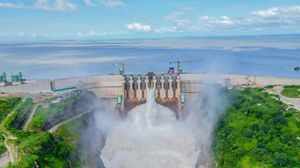
Additionally, Tanzania, which produces thousands of megawatts from hydroelectric power is well equipped to embark on renewable sources of energy such as geothermal, wind and solar. Separately, it has significant coal reserves estimated at around 1.9 billion tonnes.
Tanzania’s macroeconomic outlook is impressive too. While its GDP is close to $90 billion, economic growth as witnessed by the World Bank and the Swedish Export Credit Agency (EKN) has averaged around 5-7% annually since 2000. Notably, strong economies like Sweden, with a GDP of about $630 billion, has experienced negative growth twice in the last five years.
In July 2020, Tanzania graduated from a low-income to a lower-middle-income country, which according to the World Bank signifies strong economic progress and stability over two decades. This is the outcome of reforms in the early 1990s that moved the country to a mixed economy, a time when the political system too changed to a multiparty democracy, a process that requires decades to mature.
Tanzania received SEK 560 million in 2024, approximately $60 million, in bilateral aid from Sweden. But Tanzania is now shifting from aid to trade and investments; hence, welcomes Swedish investors in key sectors such as manufacturing, service, mining, tourism, agriculture and technology.
Noticeably, in the year ending September 2025, Tanzania collected $4.43 billion from gold, the country’s leading export commodity, while expecting tourism to bring in $6.0 billion by the end of 2025. Tanzania is currently the world’s leading safari destination for a third year consecutively, boasting itself of the Ngorongoro Crater, Serengeti National Park, Mount Kilimanjaro and the remarkable sandy beaches of Zanzibar.
Tanzania sits on huge reserves of critical minerals, ranking it third in Africa and sixth globally. Finland is graciously assisting us in exploring this unique wealth, which will certainly boost our economy. Sweden is encouraged to take advantage in establishing refinery plants in Tanzania.
In 2024 alone, Tanzania attracted FDI worth $9.31 billion from 901 registered projects, and remains food self-sufficient by 140%.
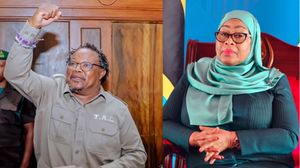
In addition to the above milestones, the current government under President Dr. Samia Suluhu Hassan continues to take a number of strategic initiatives to attain sustainable development for Tanzanians.
Thus, frankly speaking, with such a highly diversified and free-market economy that consistently demonstrates impressive growth and stability, characterising Tanzania as “too socialist with no development” is both inaccurate and unfortunate.
The author is the Ambassador of the United Republic of Tanzania to the Nordic Countries, Baltic States and Ukraine, based in Stockholm.