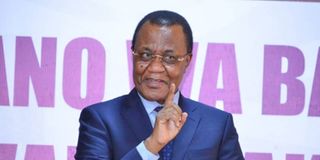
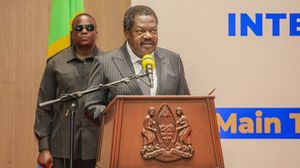
When I first entered Parliament, William Vangimembe Lukuvi was already a seasoned figure. He had served two full terms — from 1995 to 2005 — without ever sitting as an ordinary backbencher.
From the very day he stepped into the House in 1995, he was appointed Deputy Minister for Youth, and later rose to become Chief Whip of the ruling party under President Benjamin Mkapa.
That changed in 2005. When the Ninth Parliament opened, President Jakaya Kikwete did not reappoint him to the Cabinet. Instead, Lukuvi was deployed as Regional Commissioner, first for Dodoma and later for Dar es Salaam. For the first time in his long political career, he found himself a backbencher — a role that did not come easily to a man who had spent a decade on the frontlines of leadership.
It was during this period of quiet trial that Lukuvi was appointed to the Public Accounts Committee (PAC) under the chairmanship of Hon. John Momose Cheyo. This coincided with the eruption of major scandals, most notably the Alex Stewart Assayers case — a company that had been paid a significant share of gold royalties in exchange for assessing production. The Citizen newspaper, under editor Sakina Datoo, courageously exposed the scandal, and PAC brought the matter forcefully to Parliament.
It was in those intense PAC sessions that I truly saw Lukuvi’s character:
A politician who believed deeply in accountability, yet refused to allow it to destroy the image of his party. He moved with wisdom and restraint — ensuring that the committee did not turn the issue into a purely partisan witch-hunt, while at the same time insisting that the abuse must stop. In the end, PAC succeeded in removing Alex Stewart, and the government developed its own internal capacity to assess gold production. Billions in foreign exchange were saved. Lukuvi had achieved what few could: accountability without unnecessary political damage.
Return to the Front Bench – 2010
The 2010 General Elections brought Lukuvi back to the front bench. President Kikwete needed a strong, experienced Chief Whip capable of managing a new generation of young, assertive, and vocal MPs. The Ninth Parliament had exposed weaknesses in CCM’s ability to counter sharp opposition arguments. Earlier attempts with Juma Jamaldin Akukweti, Batilda Burian, and Philip Marmo had fallen short. In the end, Kikwete turned once again to Lukuvi.
In the history of our Parliament, only Anna Makinda has served longer as Chief Whip. When she became Speaker of the Tenth Parliament, Lukuvi seamlessly took over the role and was appointed Minister of State in the Prime Minister’s Office (Policy, Coordination and Parliamentary Affairs).
He discharged these demanding responsibilities with exceptional professionalism. The position of Chief Whip requires firmness, discipline, strategic skill, and, at times, toughness. Lukuvi possessed all these qualities in abundance.
Yet this second stint was far more challenging than his earlier years. Across the aisle stood Hon. Tundu Lissu — a formidable debater with deep knowledge of parliamentary procedure and an unmatched ability to elevate debate. Lukuvi defended his government with everything he had, even as we defeated him on several major issues.
Three Defining Moments
• The 2012 CAG Report — which led to the resignation of eight ministers.
• Operation Tokomeza — which claimed four more ministers.
• The Tegeta Escrow Scandal — one of the most significant tests in the history of our parliamentary democracy.
The Escrow Scandal: Honourable Opponents
The Escrow scandal brought Lukuvi and me into close and intense engagement. He fought vigorously to protect the image of his government and party, while we in the opposition, through PAC, pushed relentlessly for accountability.
On the night before the crucial motion was tabled, Lukuvi did not sleep. He walked the grounds of Parliament until dawn, trying to uncover our strategy. He failed.
The following morning, when we met, he looked at me with a wry smile and said:
“You stubborn children — you have defeated me.”
We passed the motion.
True to his character, Lukuvi accepted the outcome with political maturity and humility. He gave his full cooperation in the Parliamentary Leadership Committee to ensure that Parliament’s resolutions were implemented.
His Political Character
William Lukuvi was a politician in the truest sense — not merely an instrument of state power. He competed with ideas, not intimidation. When he lost, he accepted defeat gracefully and held no grudges. Outside the chamber, he was warm, humorous, and disarmingly engaging — quick to laugh, to tease, and to promise that he would defeat you next time.
He was also a gifted orator. Even when you strongly disagreed with him, you found yourself wanting to keep listening.
Our Final Debate
Our last major disagreement was over the Julius Nyerere Hydropower Project. As Minister for Lands under President John Magufuli, Lukuvi stood firm in defence of the project at a time when many of us expressed serious concerns about its feasibility and cost.
In that debate, it appeared that I had defeated him.
But history has proven otherwise. The project was completed. It is now generating electricity for our nation. The fears we voiced have not materialised.
How I wish I could have shaken his hand and said:
“Brother, this one — you have defeated me.”
But God, in His wisdom, has called him home.
Go well, Brother Lukuvi.
Chief Whip who truly embodied the meaning and dignity of parliamentary leadership.
May the Almighty grant you eternal rest and peace.