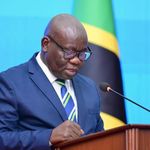
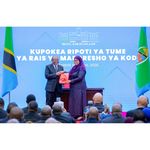
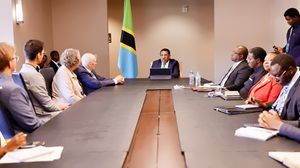
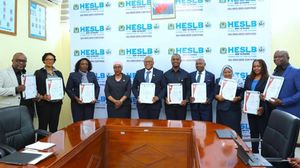
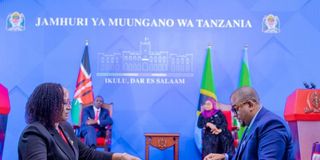
President of the United Republic of Tanzania Samia Suluhu Hassan and her guest of honour, President William Ruto of the Republic of Kenya, witnesses the signing of eight cooperation agreements between Tanzania and Kenya in various sectors at State House, Dar es Salaam, on May 4, 2026. PHOTO | STATE HOUSE
Two transactions closed within 72 hours of each other this past week, and together they answer a question sophisticated investors have been asking since last October.
On May 2, Tanzania and Helium One Global executed a Framework and Shareholders' Agreement covering 480 square kilometres, the largest mining licence ever awarded in the country, and Tanzania's first for helium. On May 4, Presidents Samia Suluhu Hassan and William Ruto signed eight cooperation agreements, set a June 30 deadline for non-tariff barrier elimination, and committed to lifting bilateral trade past $1 billion in three years.
The Songwe arrangement is a textbook deployment of the free carried interest model. The state takes a 17 percent non-dilutable equity stake in Songwe Helium Limited without upfront capital contribution;
Helium One holds 83 percent and bears development cost, with development funding still to be fully secured and first production targeted for November 2027.
What matters is the legal architecture.
The state participates as shareholder, not licensor. Decision rights, dividends and information access flow from the Shareholders' Agreement and instruments enforceable in commercial arbitration, not regulatory discretion. For a critical mineral and a market still heavily concentrated around the United States and Qatar, with concentrations of 5.5 to 7.6 per cent at Itumbula West-1, this signals jurisdictional credibility to investment committees.
The Samia–Ruto outcomes carry a complementary signal. The eight MoUs span infrastructure (railway, the Dar–Mombasa gas pipeline feasibility), trade enablers (standards, maritime transport, seafarer recognition), and institutional cooperation (mutual legal assistance, agriculture, public service).
Bilateral trade reached $860.3 million in 2025; the two economies together account for roughly 40 percent of intra-EAC trade.
The June 30 commitment to eliminate remaining non-tariff barriers is the most testable item: more than fifty NTBs have been resolved, and Article 13 of the Common Market Protocol provides the legal anchor. Whether the deadline holds will be the first measurable test of whether the new political phase translates into trade-facilitation outcomes.
The timing is the analysis, but it cuts both ways. Both deals landed in the immediate aftermath of the Chande Commission report, presented on 23 April, which recorded Sh125 billion in economic losses from the October 29 events.
Markets had already responded: on February 20, Moody's affirmed Tanzania's B1 with stable outlook, flagging political risk as the binding constraint and renewed instability as one of the clearest downgrade risks flagged by Moody’s was renewed instability that could affect investment, exports and fiscal outcomes.
FDI was recorded at $1.2 billion in the first quarter of 2026.
The rating held, but it held because October was priced as a single, contained event, and that pricing is conditional.
The full Chande report has not been made public. Chadema and ACT-Wazalendo have rejected its findings.
Police deployment across Dar es Salaam remains visible. President Samia Suluhu Hassan's reference at the Kenya – Tanzania Investment Summit of "ill-mannered children… who call themselves Gen Z" signals that the grievances the Commission identified: constitutional reform, civic space, electoral architecture, remain politically unresolved.
The floor rests on a single-event assumption. A recurrence would re-set it sharply downward, with consequences for the growth momentum Tanzania carries.
The implications for investors structuring entry now are concrete. The floor is priced, not absent and contingent, not settled.
Transaction architecture matters more than ever. Songwe works because it rests on a Framework and Shareholders' Agreement, contractual instruments with arbitration clauses, not solely a mining licence.
Investors across resource sectors and SEZs should insist on the same: stabilisation provisions, dispute resolution under recognised forums, and clear enforcement standing.
The EAC overlay is now a legal asset. Paired with the forthcoming investment-policy reforms, the Tanzania–Kenya MoUs create new layers under which investors can structure protections through the Common Market Protocol and legitimate expectations doctrine.
The honest reading is that Tanzania's investment story has not been derailed; it has been re-priced, conditionally. Sophisticated capital does not wait for risk to disappear; it waits for risk to become legible. The past week made it legible but not settled. The calendar is the moment to watch: June 30 for NTBs, November 2027 for helium production, and FYDP IV against the Sh477 trillion plan.
Amne Suedi is the Managing Director of Shikana Investment and Advisory, Honorary Consul of Switzerland in Zanzibar, and Chair of the Switzerland-Tanzania Chamber of Commerce.