Debate after opposition bigwig appointed as Deputy Minister
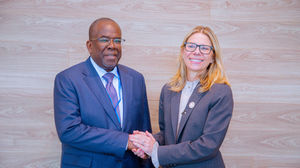
NCCR-Mageuzi Secretary General and Deputy Minister in the Prime Minister’s Office (Labour, Employment and Industrial Relations), Ms Evaline Munisi. PHOTO | COURTESY
Dar es Salaam. The appointment of NCCR-Mageuzi Secretary General Evaline Munisi as Deputy Minister in the Prime Minister’s Office (Labour, Employment and Industrial Relations) on Saturday has intensified debate across Tanzania’s political spectrum, with opposition leaders and analysts sharply divided over whether the move signals reconciliation or a calculated political strategy.
Dr Munisi’s elevation marks a historic first in the country’s multiparty system, making her the first opposition figure to serve in the cabinet.

The development comes at a time when the country is navigating a politically sensitive period, with growing calls for dialogue and reconciliation following the 2025 General Election.
Within her own party, NCCR-Mageuzi, the reaction has been particularly critical. Vice Chairman Joseph Selasini distanced the party from the appointment, arguing that Dr Munisi’s position as a presidential appointee to Parliament effectively aligns her with the executive rather than the opposition.
He questioned the ideological consistency of her new role, noting that ministers are expected to implement the ruling party’s manifesto. “The government is formed by a party whose policies were endorsed by voters. Ministers must implement those policies. Now, which agenda is she going to advance?” he asked.
Mr Selasini maintained that Tanzania does not have a formal framework for a coalition government and therefore such appointments create contradictions rather than consensus. “For us, that is no longer our member in practice. A member must stand by the party’s ideology. Serving another party’s manifesto amounts to betrayal,” he said.
However, other opposition leaders have taken a more accommodating stance. CUF Chairman Yusuf Mirambo described the appointment as a significant and positive development, noting that it is the first of its kind at cabinet level.
“It shows the government may be ready to adopt a more inclusive approach. It is a sign of willingness to work with people across political divides,” he said.
Mr Mirambo added that while the move carries the appearance of reconciliation, it does not amount to a formal coalition government, which would require structured negotiations and agreed power-sharing mechanisms among political parties.
Similarly, Chairman of the coalition of 13 opposition parties and Secretary General of the Democratic Party (DP) Abdul Mluya interpreted the appointment as a gesture of goodwill.
“The President is showing readiness to work with anyone who has the capacity to serve, regardless of political affiliation. That is a positive signal for the country,” he said.
He urged those given such opportunities to demonstrate competence and justify the trust placed in them, adding that the move should not be dismissed as political manipulation.
In contrast, Chadema Secretary General John Mnyika offered a strongly critical view, arguing that the appointment is designed to project an image of reconciliation that does not reflect reality on the ground.
“This is about creating a perception to the international community that there is reconciliation, which is not the case. There is no such a thing (Reconciliation) in Tanzania,” he said, adding that such actions risk misleading both Tanzanians and the global audience, while failing to address the core political tensions that have persisted since the last election.
ACT-Wazalendo Deputy Secretary for Information, Publicity and Public Relations Shangwe Ayo said the party is taking time to reflect on the country’s political situation.
“No comment for now. We are reflecting on the state of politics in the country and the events of October 29. Truth, justice and accountability are the only things that will heal our nation,” she said, adding that this remains the party’s immediate priority as a serious political organisation.
Adding an academic perspective, political analysts say the appointment can be interpreted as a sign of intent, but its long-term impact will depend on how it is received and implemented.
For his part, Makame Ali Ussi of the State University of Zanzibar said the move could be meaningful if it is handled in good faith by all sides.
“It will depend on how different actors interpret and respond to it. If it has been done with sincerity, then it should be sustained. Leadership opportunities should not be reserved for members of a particular party. Anyone with the ability should be given a chance to contribute to nation-building, regardless of political ideology,” he said.
A political analyst from the University of Dar es Salaam, Mr Salbinus David, echoed similar sentiments, describing the appointment as an indication of goodwill from the government.
“It demonstrates a level of openness and willingness to engage beyond partisan lines. That is an important step, especially in a period where the country is looking towards reconciliation,” he said.
Register to begin your journey to our premium contentSubscribe for full access to premium content