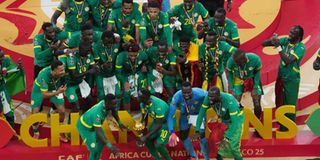
Dar es Salaam. Senegal once again underlined their status as Africa’s new standard bearers after lifting the CAF Africa Cup of Nations AFCON 2025 title with a hard fought 1–0 extra time victory over hosts Morocco in a dramatic and emotionally charged final.
More than a night of celebration, the triumph carried deeper meaning for African football. It confirmed Senegal’s transformation from perennial contenders into a sustained continental power capable of winning under pressure, adapting to different opponents and asserting authority over an entire tournament.
This latest success represents Senegal’s second Afcon crown, following their breakthrough triumph at the 2021 edition in Cameroon.
Crucially, it was not achieved through surprise or fortune, but through a familiar pattern of control, patience and resilience. In doing so, the Lions of Teranga demonstrated that their earlier success was not an isolated moment, but the foundation of a growing football dynasty built on tactical maturity, strong leadership and continuity at both technical and administrative levels.
Played before a capacity crowd in Morocco and witnessed by FIFA President Gianni Infantino, the final went far beyond a simple contest for silverware. It was a collision of footballing philosophies and national ambition, shaped by tension, fine margins and moments that will be debated long after the final whistle.
Morocco, driven by fervent home support, sought to impose themselves through controlled possession and attacking intent. Their approach reflected a golden generation that has delivered consistently on the continental stage and at the World Cup. Senegal, however, once again showed why they are so difficult to beat in decisive matches.
Their strength lay not in dominating the ball, but in structure, discipline and emotional control. Defensively compact and tactically intelligent, they absorbed pressure, limited Morocco’s clear chances and waited patiently for the right moment to strike. When extra time arrived, Senegal’s composure and depth ultimately proved decisive, allowing them to seize the defining goal while maintaining defensive solidity.
Beyond the final itself, Senegal’s Afcon 2025 campaign was marked by consistency. They navigated the tournament with minimal drama, managing matches efficiently and delivering when the stakes were highest. This ability to perform repeatedly in knockout football is the hallmark of elite teams and a key reason Senegal are now viewed as Africa’s dominant force. In contrast to past champions who briefly shone before fading, Senegal have built continuity around a core of experienced players, elite level professionals and a clear tactical identity. Their success reflects long term planning rather than short term brilliance. Ultimately, AFCON 2025 did more than add another trophy to Senegal’s cabinet. It confirmed a shift in African football’s balance of power. Senegal are no longer chasing history. They are shaping it.
A final of fine margins and high drama
As expected, the showpiece match unfolded cautiously, with both teams prioritising defensive discipline over attacking risk. Morocco enjoyed longer spells of controlled possession, patiently probing through midfield, while Senegal remained compact and disciplined, relying on quick transitions and physical presence to disrupt their hosts.
Clear chances were scarce during regulation time, largely due to the outstanding goalkeeping on display. Senegal’s Edouard Mendy and Morocco’s Yassine Bounou delivered commanding performances, repeatedly denying attackers and reinforcing their reputations as two of Africa’s finest goalkeepers.
The match took a dramatic turn deep into stoppage time. In the 98th minute, Congolese referee Jacques Ndala awarded Morocco a penalty following a VAR review, a decision that immediately ignited controversy. Senegalese players strongly protested, arguing that the incident did not warrant such a decisive sanction at that late stage.
Emotions boiled over as Senegal’s players briefly boycotted the match and walked off the pitch in protest, threatening to derail the final altogether. Order was eventually restored following intervention from match officials and tournament organisers, with Senegal captain Sadio Mané playing a crucial leadership role by calling his teammates back onto the field. When play resumed, Moroccan forward Brahim Díaz stepped up to take the penalty amid deafening noise from the home crowd. However, Mendy rose to the occasion, producing a brilliant save that not only denied Morocco a late winner but also swung the psychological momentum firmly in Senegal’s favour.
Extra time composure seals Senegal’s glory
The dramatic escape forced the match into extra time, where fatigue became evident and mental strength emerged as the defining factor. As the additional period progressed, Senegal’s superior composure and tournament experience began to tell. While Morocco struggled to regain their rhythm after the late drama, the Teranga Lions remained focused and patient. Their decisive moment arrived when they capitalised on a rare defensive lapse. Midfielder Pape Gueye timed his run perfectly and finished clinically past Bounou, sending the Senegal bench into celebration and silencing the home crowd. Gueye’s goal proved decisive, crowning a performance built on discipline, belief and tactical maturity.
From that point on, Senegal expertly managed the game, absorbing late pressure, closing down space and controlling the tempo until the final whistle confirmed their return to the summit of African football. The celebrations that followed underlined how far Senegal have come, not merely as champions, but as a model of consistency and maturity on the continental stage.
Sadio Mané crowned Player of the Tournament
Beyond lifting the AFCON trophy, Senegal talisman Sadio Mané was deservedly named Player of the Tournament, a fitting reward for his leadership, influence and match defining presence throughout the competition.
While Mané did not dominate headlines solely through goals, his impact was felt in decisive moments both on and off the pitch. His calming intervention during the penalty controversy in the final symbolised his importance as a leader, while his performances across the tournament embodied Senegal’s collective strength and resilience.
Mané’s award reflected the balance Senegal struck at Afcon 2025, where individual excellence consistently served the greater good of the team. How Senegal built a second crown
Senegal’s Afcon 2025 success was built not on flamboyance, but on control, balance and consistency. Throughout the tournament, the Lions of Teranga demonstrated remarkable tactical discipline, particularly in the knockout stages where game management proved decisive. Their defensive unit ranked among the most reliable in the competition, while the midfield provided both protection and creativity. In attack, Senegal avoided over reliance on a single scorer, instead embracing a collective approach that made them unpredictable and difficult to contain.
Winning a second AFCON title within four years elevates Senegal into a rare bracket in African football history and confirms that their 2021 triumph was the foundation of an era, not its peak.
Morocco’s pride despite heartbreak
For Morocco, defeat in the final was painful, especially on home soil, but their AFCON 2025 campaign was rich in positives. The Atlas Lions reached the final after conceding just two goals throughout the tournament, underlining their defensive solidity. Their discipline was recognised with Morocco winning the Fair Play Award, reflecting their professionalism and conduct across the competition. Team captain Achraf Hakimi was also individually honoured for his leadership and consistency, further highlighting Morocco’s organisational strength.
Goalkeeper Yassine Bounou was deservedly awarded the AFCON 2025 Golden Glove after keeping five clean sheets, joint most in the tournament alongside Mendy. His calm presence and match saving interventions were instrumental in Morocco’s run to the final.
Brahim Díaz the attacking benchmark of the tournament
If Bounou symbolised Morocco’s defensive excellence, Brahim Díaz embodied their attacking ambition. The Real Madrid forward finished as the Golden Boot winner with five goals, emerging as one of the tournament’s most decisive attackers.
Díaz scored in five different matches, a rare achievement, and found the net at every crucial stage of the competition. His penalty miss in the final, brilliantly saved by Mendy, proved a defining moment, but it did little to overshadow his overall contribution.
Notably, Díaz also finished as top scorer in the AFCON 2025 qualifiers, completing a rare double that underscored his growing influence in African football.
A tournament reflecting Africa’s growth
Afcon 2025, hosted by Morocco, showcased the tactical evolution and increasing depth of African football. Defensive organisation, elite goalkeeping and improving officiating standards, despite moments of controversy, highlighted a competition continuing to grow in global stature.
Senegal’s triumph reinforced the value of squad balance, experience and leadership, while Morocco’s near miss demonstrated that hosting can amplify performance without guaranteeing success.
The legacy of Afcon 2025
As celebrations continue in Dakar, Senegal’s second AFCON title will be remembered as confirmation of sustained excellence and continental maturity. For Morocco, the tournament stands as one of pride, progress and painful lessons, defined by individual honours and a final that slipped away in dramatic fashion.
Ultimately, AFCON 2025 told a timeless football story. Individual brilliance can illuminate a tournament, but collective strength wins championships. Senegal mastered that balance once again and, in doing so, wrote another golden chapter in African football history.
Register to begin your journey to our premium contentSubscribe for full access to premium content